


A Digital Product & AI Engineering Partner for Ambitious Businesses.
Freelancer, in house hire, agency or AI tools: which fits your product?
Gr8r Studio's AI development agency comparison covers six ways to build an AI or SaaS product. A freelancer suits one clear task. An in house hire suits daily work for years. A big agency suits large programmes. AI tools suit testing an idea. A design subscription suits small requests. One partner team suits a product due by a date.
Updated 26 Oct 2026. Last checked: 26 Oct 2026.
Every comparison
Who should build it
 Freelancer vs agency for an MVP: who should build your first version?Freelancer vs agency for an MVP: who joins design and code, who carries the risk, who owns the files, and when one freelancer is the better pick.
 AI development agency vs in house team: hire, or bring in a partner?AI development agency vs in house team: when a hire wins, when a partner ships faster, who owns the work, and how teams use both one after the other.
 Design agency or engineering partner: design files, or a working product?SaaS design agency or design subscription, or one team that designs and builds? Who writes the code, who owns the files, and when each one wins.
 Product partner vs software development agency: build only, or design and build?Product partner vs software development agency: build from a finished design, or design and build with one team? Who owns the risk, and when each wins.
 AI app builder vs development agency: keep prompting, or bring in a team?AI app builder vs development agency: what Bolt, v0 and Figma Make do well, who owns the output, and the signs it is time to bring in a team.
 Automation agency, in house hire or no code tools: who should run your workflows?Automation agency, in house hire, Zapier, Make or n8n, or custom AI development: what each suits and where each stalls. Checked 26 Oct 2026.
Which platform
 Framer vs WebflowFramer vs Webflow compared on CMS limits, editing, SEO, localization, ecommerce and code export, plus when custom code fits better. Checked 26 Oct 2026.
 Next.js vs FramerNext.js vs Framer: when to stay on Framer, when to move to code, what each costs to run, and how to move without losing rankings. Checked 26 Oct 2026.
 Framer vs WordPressFramer vs WordPress for a marketing site: editing, CMS limits, hosting, upkeep and SEO, plus how to switch from WordPress to Framer. Checked 26 Oct 2026.
 Webflow vs WordPressWebflow vs WordPress for SEO, content sites and ecommerce: CMS limits, hosting, upkeep and code export, from official pages. Checked 26 Oct 2026.
 Next.js vs WordPressNext.js vs WordPress: classic WordPress, a Next.js build, or headless WordPress with Next.js. Who edits, upkeep and SEO. Checked 26 Oct 2026.
 Astro vs Next.js for Marketing Sites (2026)Astro vs Next.js for a marketing site: rendering, content, headless CMS, hosting and SEO, and when each one fits, from official docs. Checked 26 Oct 2026.
 Webflow vs Next.jsWebflow vs Next.js, or Webflow vs custom code: who edits, CMS, hosting, SEO, cost model and moving from Webflow to Next.js. Checked 26 Oct 2026.
 Framer vs Astro for a Marketing Site (2026)Framer vs Astro for a marketing site: canvas or code you own, CMS, hosting, SEO, cost, and whether marketers can edit Astro. Checked 26 Oct 2026.
 Astro vs WebflowAstro vs Webflow for a content heavy SaaS site: CMS limits, editing, hosting, ecommerce, SEO and ownership, from official docs. Checked 26 Oct 2026.
 WordPress vs AstroWordPress vs Astro: stay, migrate WordPress to Astro, or keep WordPress as a headless CMS with Astro. Upkeep, SEO and cost. Checked 26 Oct 2026.
Who we are: Gr8r Studio is a Digital Product & AI Engineering Partner for Ambitious Businesses: 15+ team members, in house & remote, founded 2023, with 50+ projects shipped across product design, engineering and websites. Founder and CEO: Tanjim Islam.
Six ways to get it built, side by side
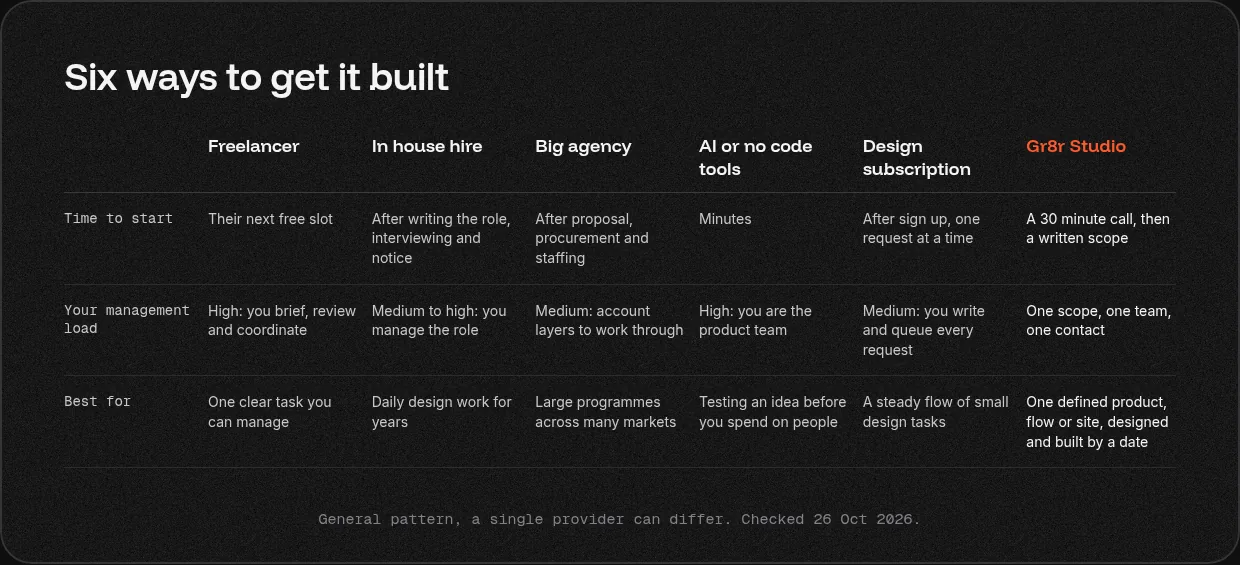
| Freelancer | In house hire | Big agency | AI or no code tools | Design subscription | Gr8r Studio | |
|---|---|---|---|---|---|---|
| Who does the work | One person | One employee per hire, plus whoever manages them | Layered teams; the people who pitch may not do the work | You, prompting the tool | A designer working through a request queue; ask who | 15+ team members, in house & remote: product designers, engineers and web developers on one team |
| Time to start | Their next free slot | After writing the role, interviewing and notice | After proposal, procurement and staffing | Right after sign up | After sign up, one request at a time | A 30 minute call, then a written scope |
| First output | Depends on their calendar | After onboarding | After discovery phases | Depends on the tool and the prompt | Per request, on the provider's turnaround | First concept within 48 hours of kickoff, a revised draft by day 2 to 3 |
| Design to working code | Usually one or the other | Depends on who you hire | Often separate teams or a second vendor | The tool writes code; review is on you | Design files; builds vary | Designed and built by the same team |
| Use of AI | Depends on the person | Depends on who you hire | Varies; often a separate offer | The whole product of the tool | Varies | AI Automation used where it helps; people review what ships |
| Your management load | High: you brief, review and coordinate | Medium to high: you manage the role | Medium: account layers to work through | High: you are the product team | Medium: you write and queue every request | One scope, one team, one contact |
| Continuity risk | Single person risk | Leave and resignation risk | Staff rotation between accounts | Platform and plan changes | Designer rotation between requests | A team with shared files and a design system |
| Cost model | Hourly or per job | Salary plus recruiting, tools and management time | Retainer or large project fees | Set by each tool's own plan; check its pricing page | Flat monthly fee, busy or not | Scoped project, agreed in writing before work starts |
| Who owns files and code | Per your contract; write it down | You, as employer | Per contract | Per each tool's terms (Bolt, Figma Make and v0 sources below, checked 26 Oct 2026) | Per contract | Clients own everything once it's paid for. |
| Who maintains it after launch | The same person, if they are free | Your hire | Per contract, often a retainer | You | The subscription, while you pay | Support after launch is set in the written scope; then your team or ours |
| Where the risk sits | With you: you join the pieces | With you: hiring and managing | With layers of handover | With you: unreviewed code | With you: one request at a time | With one team that answers for design and build |
| Best for | One clear task you can manage | Daily design work for years | Large programmes across many markets | Testing an idea before you spend on people | A steady flow of small design tasks | One defined product, flow or site, designed and built by a date |
These describe each type of option in general. Any single provider can differ. Last checked: 26 Oct 2026.
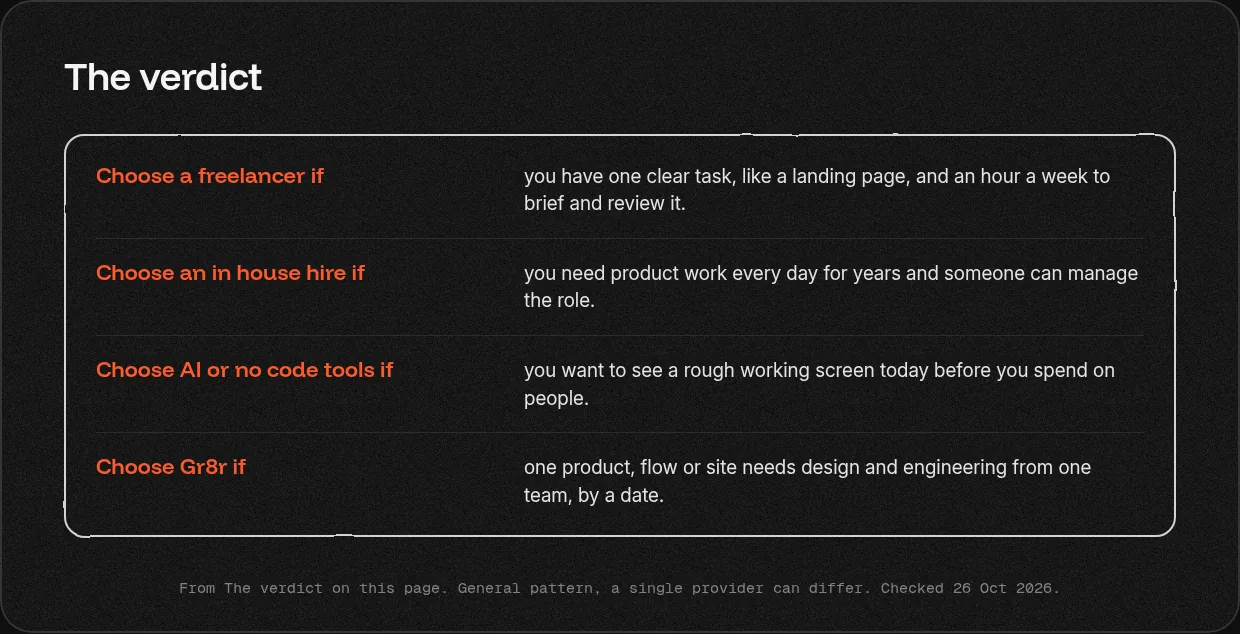
The verdict
- Choose a freelancer if you have one clear task, like a landing page, and an hour a week to brief and review it.
- Choose an in house hire if you need product work every day for years and someone can manage the role.
- Choose AI or no code tools if you want to see a rough working screen today before you spend on people.
- Choose Gr8r if one product, flow or site needs design and engineering from one team, by a date.
Sources
- Bolt: StackBlitz Terms of Service (covers bolt.new), last updated 22 Sep 2026. You keep all rights in your User Content, which includes AI Output, and StackBlitz assigns you its rights in AI Output, if any. The same or similar output may go to other users. Unless you opt out, eligible Bolt content created from 7 Oct 2026 may be used to train models. https://stackblitz.com/terms-of-service, checked 26 Oct 2026.
- Figma Make: Figma AI Terms, effective 24 Jun 2026. You keep all rights in Figma AI Input and Output, code included. https://www.figma.com/legal/ai-terms/, checked 26 Oct 2026.
- v0: Vercel AI Product Terms, last updated 17 Mar 2026. You own your inputs, and Vercel assigns you its rights in Output, if any. Similar output may go to other users. https://vercel.com/legal/ai-product-terms, checked 26 Oct 2026.
- Rows about freelancers, in house hires, big agencies and design subscriptions describe types of provider, in our experience. They name no provider and quote no figures. Checked 26 Oct 2026.
Last checked: 26 Oct 2026.
Choose each option when
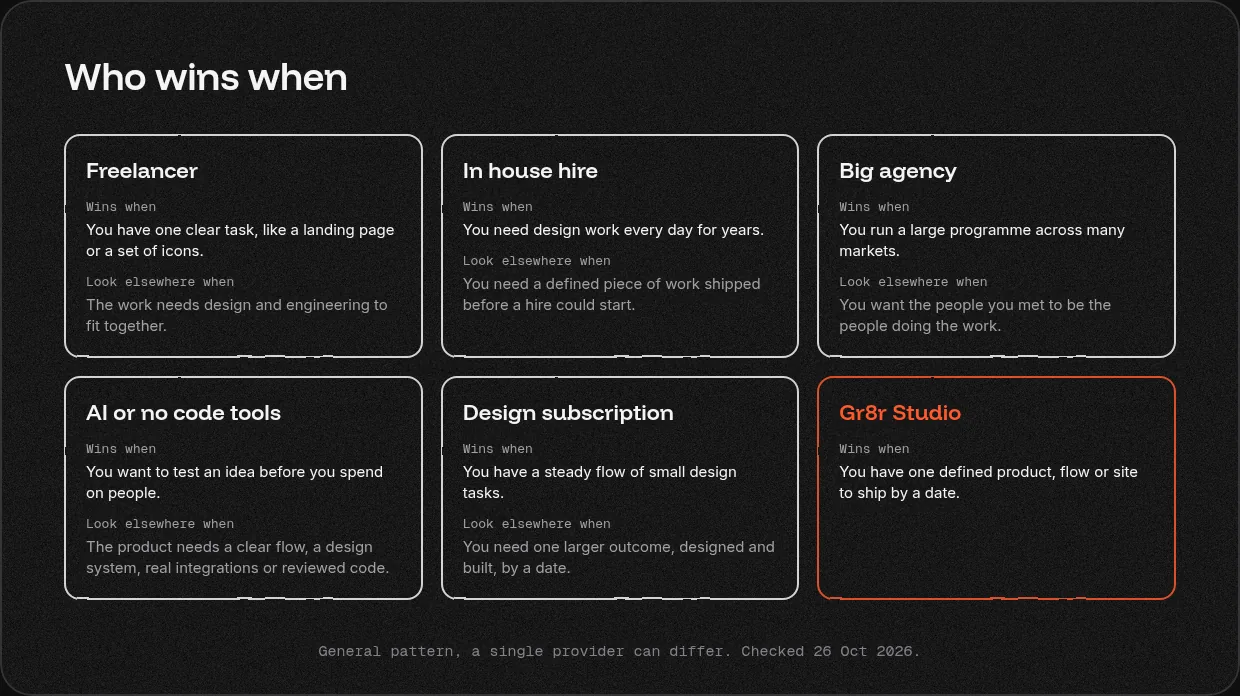
Freelancer
Choose it when:
- You have one clear task, like a landing page or a set of icons.
- You have time to brief, review and chase the work yourself.
Look elsewhere when:
- The work needs design and engineering to fit together.
In house hire
Choose it when:
- You need design work every day for years.
- Someone on your team can manage and grow the role.
- You want product knowledge to stay inside the company.
Look elsewhere when:
- You need a defined piece of work shipped before a hire could start.
Big agency
Choose it when:
- You run a large programme across many markets.
- You need formal procurement, many roles and layers of review.
Look elsewhere when:
- You want the people you met to be the people doing the work.
- One product or site needs to ship soon.
AI or no code tools
Choose it when:
- You want to test an idea before you spend on people.
- A rough working screen is enough for now.
Look elsewhere when:
- The product needs a clear flow, a design system, real integrations or reviewed code.
Design subscription
Choose it when:
- You have a steady flow of small design tasks.
- One request at a time suits your pace.
Look elsewhere when:
- You need one larger outcome, designed and built, by a date.
Gr8r vs a design agency or design subscription
Gr8r Studio
Choose us when:
- You have one defined product, flow or site to ship by a date.
- You want design and engineering from the same team.
- You want AI used where it helps, with people reviewing what ships.
When we're the wrong choice
We would rather tell you now than halfway through a project.
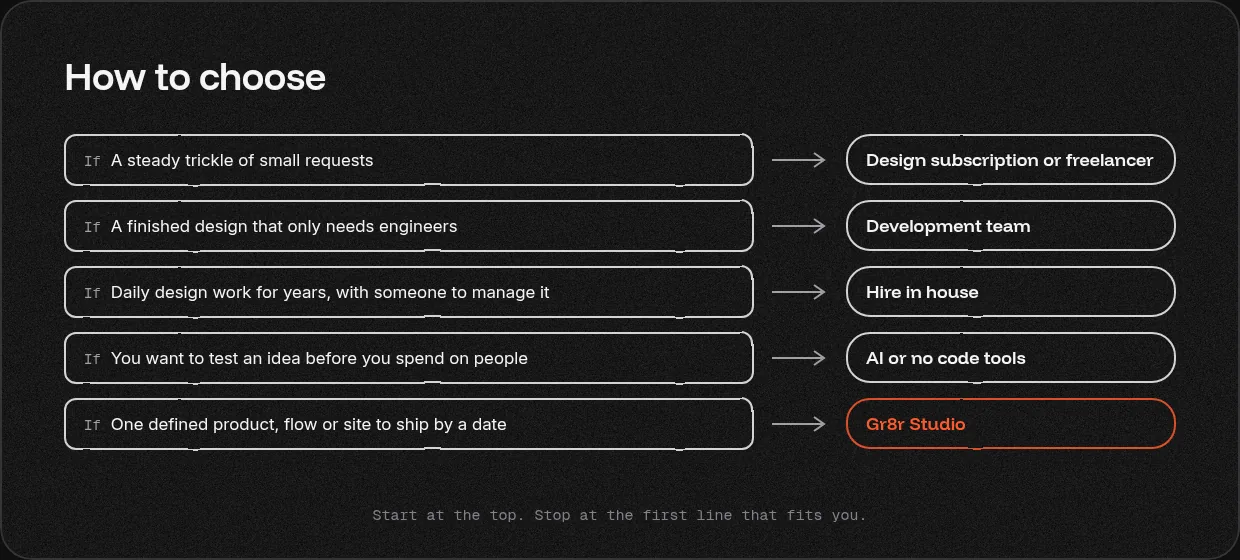
- A steady trickle of small requests. A design subscription or a freelancer will suit you better.
- A finished design that only needs engineers. A development team is the simpler fit. See Gr8r vs a development shop.
- Daily design work for years, with someone to manage it. Hire in house. See Gr8r vs an in house hire.
How a Gr8r project starts
- A 30 minute call. You tell us what you are trying to solve.
- A written scope. We begin with a defined scope and clear deliverables before recommending a larger build. More on how we scope engagements.
- First concept within 48 hours of kickoff, a revised draft by day 2 to 3.
See our process. The services behind these pages: product design, MVP development, AI software development, AI Automation, website design and development and Framer.
Our view
We start by asking what has to be live, and by when. If the answer is one product with screens, code and a site, we fit. If you need a steady trickle of small fixes, a single build after the design is signed off, or a person at a desk for years, we are the wrong choice, and we will say so on the first call.
Work you can check
- HostOp (hostop.ai): For HostOp, we designed the product, built its Framer website and built an agentic design system for it. Read the HostOp case.
- Savari (savari.io): For Savari, we designed and built the website in Framer.
- Orthotropic (orthotropicbd.com): We designed and built the Orthotropic website in Webflow.
- Ask Ali (ali-assistant-blush.vercel.app): An AI assistant you can ask anything. Built by Gr8r for its own portfolio. Not client work. See all products we design and build for ourselves.
50+ projects shipped across product design, engineering and websites.
Compare in detail
- Gr8r vs an in house hire: When a hire fits, when a partner fits, and how teams use both.
- Gr8r vs a freelancer: One person for one task, or one team for a product.
- Gr8r vs a design agency or design subscription: Request queues, big agency process and scoped partner projects side by side.
- Gr8r vs a development shop: For when you have designs and wonder who should build them.
- Gr8r vs AI app builders: What AI, no code and automation tools do well, and where people still need to step in.
- AI Automation agency vs Gr8r: An agency wiring up your tools, an in house automation hire, no code tools, or a team that builds the screens around the workflow.
Platform comparisons
- Framer vs Webflow, and when custom code is the better call
- Next.js vs Framer: When to Move Off a Builder
- Framer vs WordPress: Which Fits a Modern Site
- Webflow vs WordPress: Which to Choose in 2026
- Next.js vs WordPress: Code or CMS in 2026
- Astro vs Next.js for Marketing Sites (2026)
- Webflow vs Next.js: Visual Builder or Code
- Framer vs Astro for a Marketing Site (2026)
- Astro vs Webflow: Code Site or Visual CMS
- WordPress vs Astro: Should You Rebuild?
- Moving platforms? See migrations
Options to automate business workflows
Three routes are common: an automation agency that builds inside a platform, an in house hire, or a tool you set up yourself in a visual editor. AI Automation agency vs Gr8r sets them side by side.
What to read next?
- Freelancer vs agency for an MVP
- AI development agency vs in house team
- AI app builder vs development agency
- Product design
- Every way to get it built
Questions people ask
Who should build my AI product?
It depends on the size of the job and who will manage it. A freelancer fits one clear task. An in house hire fits daily work for years. A big agency fits large programmes. A partner such as Gr8r fits one defined product that needs design and engineering together, shipped by a date.
What are the ways to build an AI product?
There are six common routes: a freelancer, an in house hire, a big agency, AI or no code tools, a design subscription, or one partner team. Each one moves the work and the risk to a different place. The table on this page shows who does the work, how fast it starts and who owns the result.
When is a freelancer the better choice than an engineering partner?
A freelancer is the better choice when you have one clear task and time to manage it. A logo refresh, one landing page or a set of icons often fits one skilled person. An engineering partner makes more sense when the work spans product design and engineering and you want one team to own it.
Should we hire in house instead of working with an engineering partner?
Hire in house if you need product work every day for years and someone can manage that person. A hire builds deep product knowledge over time. Work with a partner when you need a defined product, flow or site shipped by a date, or want design and engineering together before you hire.
Can AI or no code tools replace a design and engineering team?
Sometimes, for testing an idea. AI or no code tools can put a working screen in front of you quickly, and that is often the right first step. They fall short when the product needs a clear flow, a design system, real integrations or code a person has reviewed. Then you need people.
How much does it cost to build a SaaS product?
It depends on scope, the size of the team and how much rework the first version needs. One clear flow costs less to build than a full product with AI features and integrations. Gr8r sets the cost in a written scope after a 30 minute call, so you see it before any work starts.
Who owns the designs and code?
Clients own everything once it's paid for. With Gr8r, the files, the code and the logins live in your own accounts from day one. With other options, ownership depends on the contract or on each tool's terms, so read them and write the answer down before any work starts.
How long does it take to build a SaaS product?
It depends on scope and on how fast decisions get made. A small first release with one core flow ships sooner than a full product with AI features and integrations. Gr8r sets the timeline in the written scope; you get a first concept within 48 hours of kickoff, a revised draft by day 2 to 3.
Tell us what you're trying to solve.
Book a 30 minute call or email hello@gr8rstudio.com.