


Automation agency, in house hire or no code tools: who should run your workflows?
An automation agency suits wiring up tools you already use. An in house hire suits workflows that change every week. No code tools like Zapier, Make or n8n suit one person testing a single workflow. Custom AI development, from a team like Gr8r Studio, suits workflows that need their own screens, logins or logic.
Updated 26 Oct 2026. Last checked: 26 Oct 2026.
Who we are: Gr8r Studio is a Digital Product & AI Engineering Partner for Ambitious Businesses: 15+ team members, in house & remote, founded 2023, with 50+ projects shipped across product design, engineering and websites.
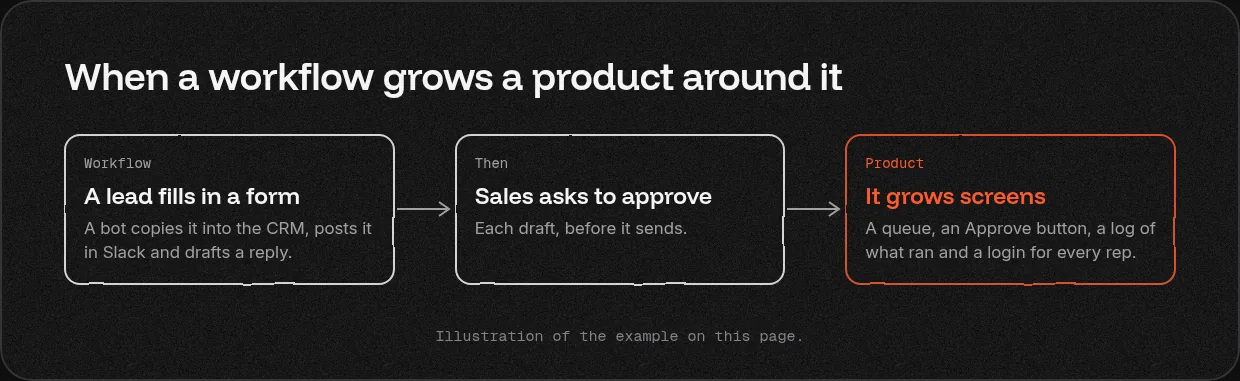
A lead fills in a form. A bot copies it into the CRM, posts it in Slack and drafts a reply. That is a workflow, and an agency, a hire or a no code tool can run it well.
Then sales asks to approve each draft before it sends. Now there is a queue, an Approve button, a log of what ran and a login for every rep. The workflow has grown a product around it, and a product needs design and engineering.
Side by side
| Automation agency | In house automation hire | No code tools you run | Gr8r Studio | |
|---|---|---|---|---|
| Who does the work | Specialists who build inside an automation platform | One employee, plus whoever manages them | You, in a visual editor | 15+ team members, in house & remote: product designers, engineers and web developers on one team |
| Time to start | After a proposal | After writing the role, interviewing and notice | Right after sign up | A 30 minute call, then a written scope; first concept within 48 hours of kickoff, a revised draft by day 2 to 3 |
| What you get | Running workflows in a platform account | Workflows, plus a person who knows them | Workflows you built yourself | Workflows, plus the screens, logins and code around them |
| Range of skills | Automation; product design is often out of scope | What one person brings | Whatever the platform can do | Product design, engineering, websites and AI Automation in one team |
| Your management load | Medium: you explain each process and approve changes | Medium to high: you manage the role | High: you build, test and fix every run | One scope, one team, one contact |
| Continuity risk | Staff rotation between accounts | Leave and resignation risk | Platform plan and pricing changes | A team with shared files and a design system |
| How usage is billed | Per contract, plus your platform plan | Salary, plus your platform plan | Per task on Zapier, per credit on Make (sources below, checked 26 Oct 2026) | Scoped project, agreed in writing before work starts |
| Who owns files and code | Per contract | You, as employer | Workflows sit in your platform account; n8n can also run on your own servers (source below, checked 26 Oct 2026) | Clients own everything once it's paid for. |
| Who maintains it after launch | Per contract, often a retainer | Your hire | You | Support after launch is set in the written scope; then your team or ours |
| Where the risk sits | With the agency's platform choices | With one person's knowledge | With you: you build, test and fix every run | With one team that answers for design and build |
| Best for | Connecting tools you already use | Workflows that change every week | Testing one workflow yourself | A workflow that needs its own screens, logins or logic the platform cannot hold |
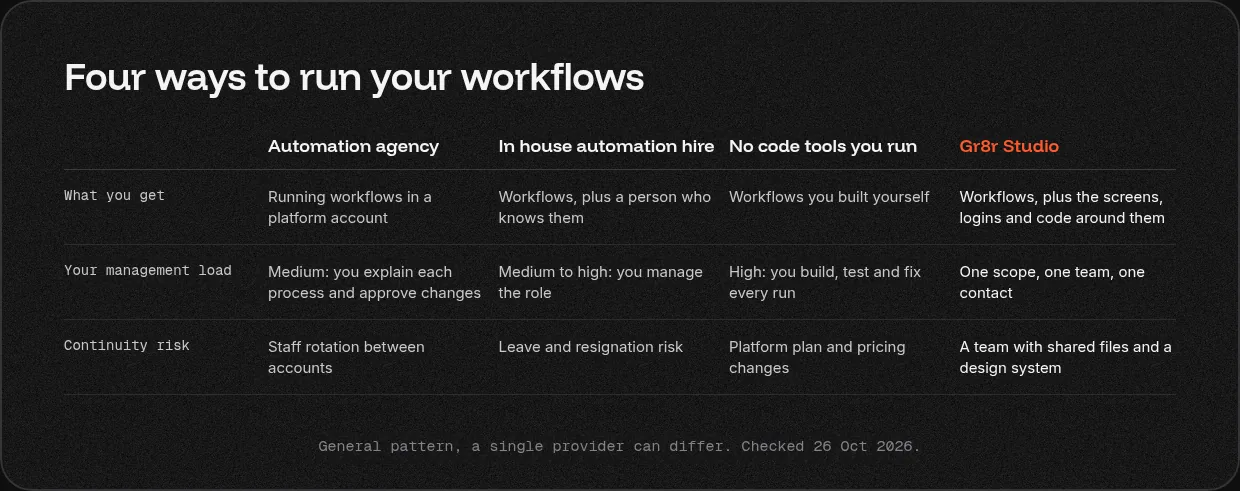
These describe each type of option in general. Any single provider can differ. Last checked: 26 Oct 2026.
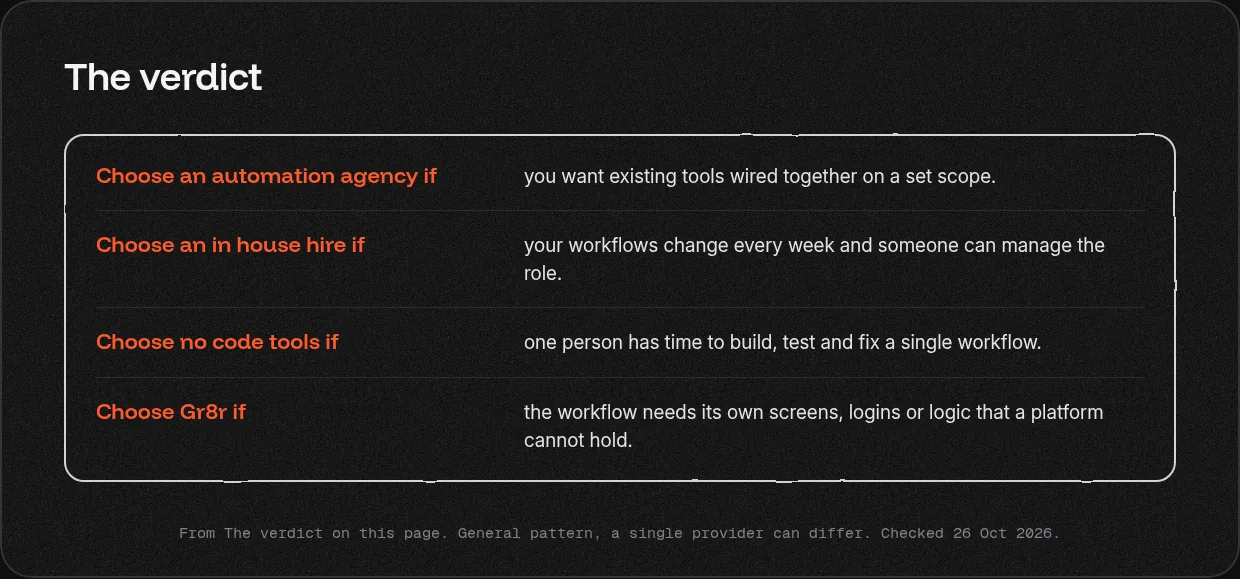
The verdict
- Choose an automation agency if you want existing tools wired together on a set scope.
- Choose an in house hire if your workflows change every week and someone can manage the role.
- Choose no code tools if one person has time to build, test and fix a single workflow.
- Choose Gr8r if the workflow needs its own screens, logins or logic that a platform cannot hold.
Choose an automation agency if
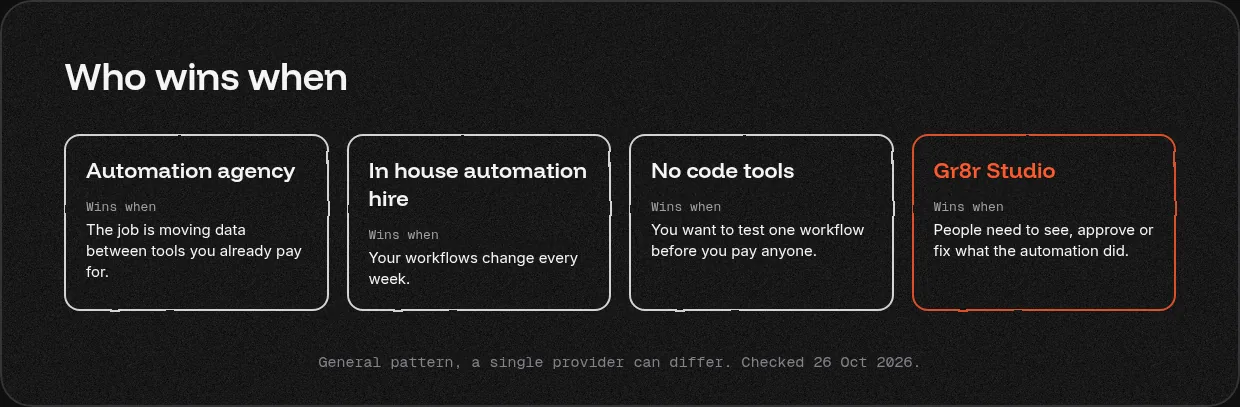
- The job is moving data between tools you already pay for.
- You can describe each process step by step.
- Nobody outside your team needs to log in.
Choose an in house automation hire if
- Your workflows change every week.
- Someone on your team can manage the role.
Choose no code tools if
- One person on your team has time to build and fix workflows.
- You want to test one workflow before you pay anyone.
Choose Gr8r if
- People need to see, approve or fix what the automation did.
- The workflow needs logic the platform cannot hold.
- You want the screens and the AI Automation built by one team.
The service behind this page: AI Automation. For AI app builders, see Gr8r vs AI app builders.
When we're the wrong choice
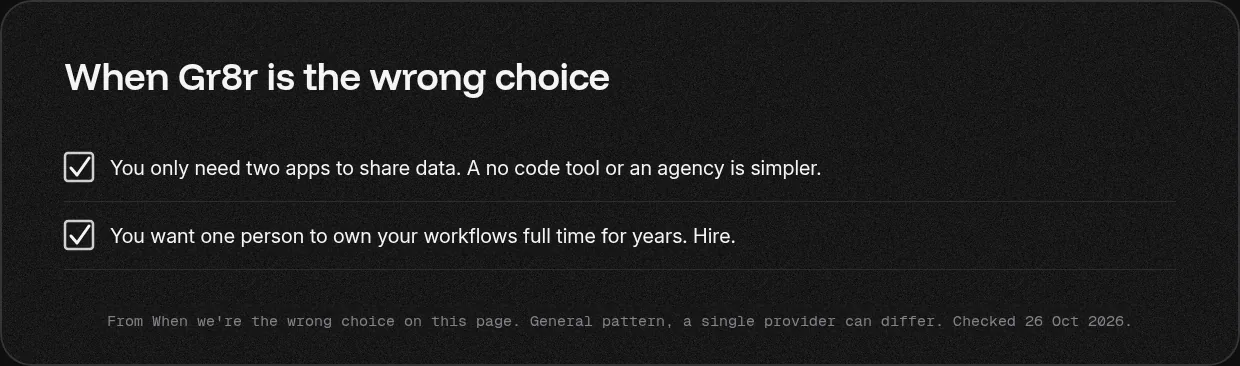
- You only need two apps to share data. A no code tool or an agency is simpler.
- You want one person to own your workflows full time for years. Hire.
Our view
We fit when a workflow grows into a product: screens, logins, data and logic around the automation. If you only need two tools connected, a no code tool or a small automation agency will be quicker and cheaper. If your processes change every week, a hire who sits with the team is the better choice. Clients own everything once it's paid for.
Work you can check
- Relay (relay-workflow-os.vercel.app): A workflow OS where agents do the busywork. Built by Gr8r for its own portfolio. Not client work.
We have no AI Automation client work to show yet. 50+ projects shipped across product design, engineering and websites. Read client reviews on Contra
What to read next?
- AI development agency vs in house team
- Freelancer vs agency for an MVP
- AI app builder vs development agency
- AI Automation
- Every way to get it built
Questions
Should I use an automation agency or custom AI development?
An automation agency wires your existing tools together inside a platform like Zapier, Make or n8n. Custom AI development builds what the platform cannot hold: its own screens, logins, data or logic. Start with the platform if it covers the workflow, and move to custom work when it stops fitting.
Should I hire an automation agency or do it in house?
Hire in house if your workflows change every week and someone can manage the role. Use an agency to connect tools you already use, on a set scope. Do it yourself with no code tools if one person has the time to build, test and fix every run.
n8n agency vs custom software: which fits?
n8n can run on your own infrastructure, and without a license key it runs as the free Community edition, so an n8n build keeps workflows in a tool you control. Custom software fits when the workflow needs its own interface, user accounts or logic that a workflow tool cannot express cleanly.
Zapier vs a custom workflow: when do I switch?
Stay on Zapier while the workflow fits its steps and your task allowance; tasks are used each time a Zap completes an action, and triggers do not count. Switch to a custom build when the workflow needs screens, logins, complex logic or data the platform cannot hold.
What happens when a Make plan runs out of credits?
Make bills in credits, and most actions use one credit. When credits run out, scenarios stop running until more credits are added. Check usage before a busy month, and build alerts into any workflow your business depends on, whichever platform you choose to run it on.
Who owns the workflows?
On a no code platform, workflows sit in your platform account, so keep that account in your company's name. With a hire, you own the work as the employer. With an agency, ownership follows the contract. With Gr8r, clients own everything once it's paid for.
Sources
- Zapier: tasks are used when a Zap successfully moves data or completes an action; triggers don't count toward your task limit. https://zapier.com/pricing, checked 26 Oct 2026.
- Make: credits are the billing unit; most actions consume 1 credit, and scenarios won't continue to run until credits are added again. https://www.make.com/en/pricing, checked 26 Oct 2026.
- n8n: you can self host n8n on your own infrastructure; without a license key it runs as the free Community edition. https://docs.n8n.io/hosting/, checked 26 Oct 2026.
- Rows about agencies and hires describe types of provider, in our experience. They name no provider and quote no figures. Checked 26 Oct 2026.
Last checked: 26 Oct 2026.
Next step
Book a 30 minute call or email hello@gr8rstudio.com. Or go back to every way to get it built.