

What Drives the Cost to Build an AI App

Tanjim Islam
Founder & CEO · · 7 min read


AI app development cost depends on five things: how many systems the app connects to, whether it only answers or also takes actions, how thoroughly it is tested, how many review screens people need, and how often it runs. The first four drive the build. The last drives a separate monthly bill, mostly model usage, which you can estimate before you sign anything.
Contents
- Why do AI app quotes differ so much?
- What are the five drivers of AI app cost?
- What is the difference between build cost and running cost?
- How do you estimate the monthly model bill?
- How do you scope a first version that costs less?
- What should you ask about any quote?
- What does Gr8r charge?
- Frequently asked questions
Why do AI app quotes differ so much?
Because two people asking for "an AI app" often mean very different things. One means a chat box over a help center. The other means an agent that reads contracts, updates a CRM and emails customers. Both get called an AI app. The second can take many times the work.
Quotes also hide different assumptions. One includes design and testing, another leaves them out. One prices a demo, another prices something your team will run every day. Before comparing numbers, compare what each quote assumes on the five drivers below.
What are the five drivers of AI app cost?
The five drivers are systems touched, answers or actions, testing depth, review screens and run volume.
1. Systems touched
Every connection to another system is work: your CRM, your accounting tool, a shared drive, an internal database. Each needs access, error handling and a plan for when that system is down. One system is cheap. Five is a different project.
2. Answers or actions
An app that answers questions can be wrong, and someone reads it and moves on. An app that acts, by sending, editing or paying, can be wrong in ways that cost money. Actions need permissions, approvals, logs and undo. That is more design and more engineering.
3. Testing depth
AI output varies, so you test it against a set of real examples with known good answers, and rerun that set every time you change a prompt or a model. Building that set takes time from people who know the work. Skipping it is the most common way a cheap build becomes an expensive one later.
4. Review screens
Most budgets forget the interface around the AI: the queue where people approve actions, the screen that shows what changed, the inbox for exceptions, the log. These are real screens with real states. A workflow that sends ten percent of its cases to a person needs a good screen for that ten percent.
5. Run volume
How many requests, documents or conversations per month. Volume barely moves the build cost, but it sets the running cost and decides whether you need batching, caching and monitoring from day one.
What is the difference between build cost and running cost?
Build cost is paid once: discovery, design, engineering, integrations, the test set and launch. Running cost is paid every month: model usage, hosting, monitoring, and someone to maintain the app and rerun tests when models change.
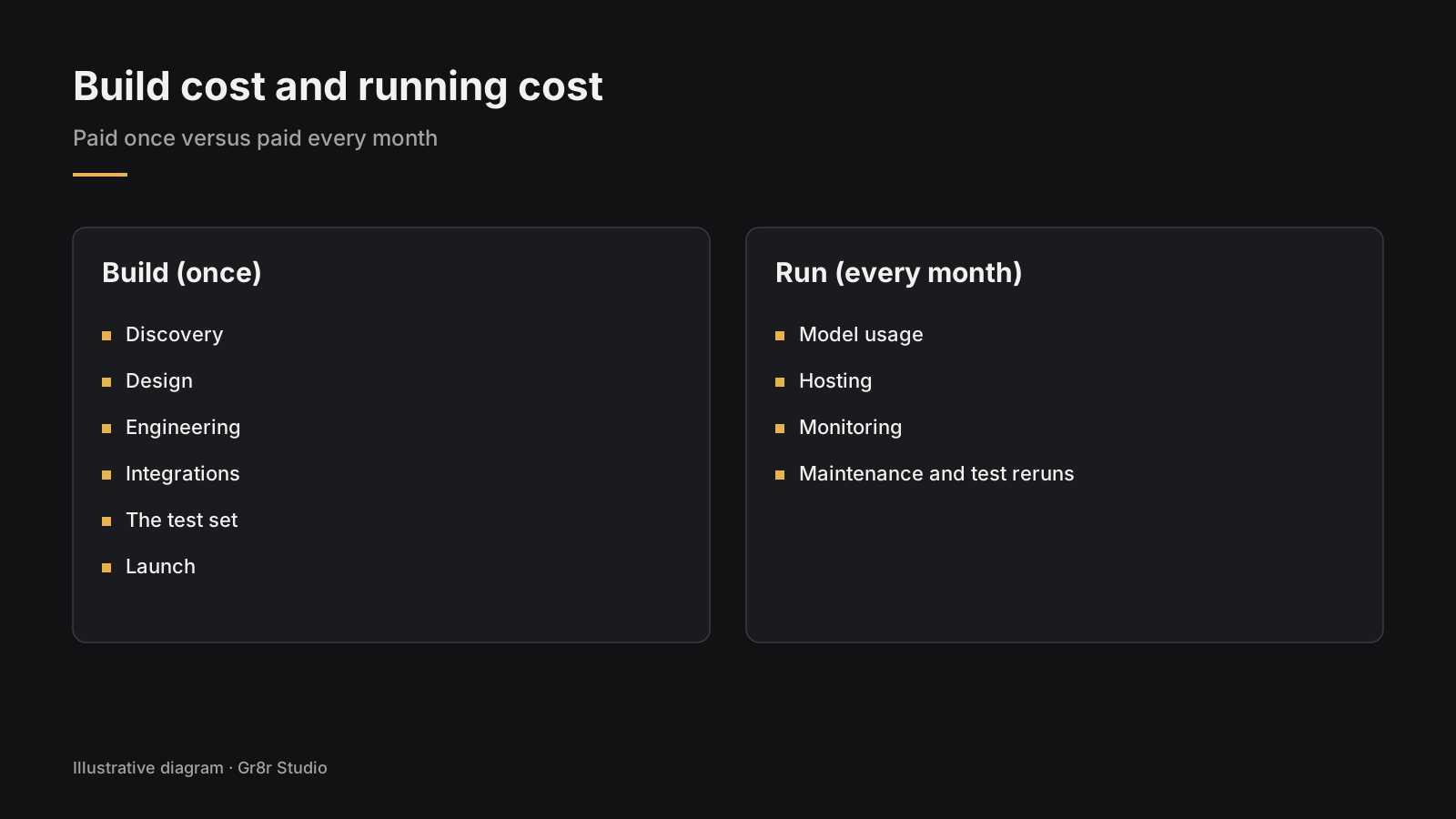
Ask every quote to show both. A low build price with no plan for running cost is only half a number.
How do you estimate the monthly model bill?
Model providers publish prices per million tokens, split into input (what you send) and output (what comes back). Multiply by your volume.
A worked example, using one provider's list prices as listed when we checked on 6 Nov 2026. This is for illustration only, not a recommendation. Anthropic lists Claude Sonnet 5 at $2 per million input tokens and $10 per million output tokens (Anthropic, Claude API pricing, undated page, checked 6 Nov 2026).
Say the app reads 10,000 documents a month. Each sends about 3,000 tokens in and gets about 500 tokens back.
- Input: 10,000 × 3,000 = 30 million tokens × $2 = $60
- Output: 10,000 × 500 = 5 million tokens × $10 = $50
- Model cost: about $110 a month
Two published levers lower that. The same pricing page lists a Batch API with "a 50 percent discount on both input and output tokens" for work that can wait, and prompt caching, where a cache hit costs a fraction of the normal input price (Anthropic, Claude API pricing, undated page, checked 6 Nov 2026).
Your real numbers will differ: other models cost more or less, and agents that call tools or loop through several steps use many more tokens per task. Measure tokens on real examples during the build, then update the estimate. To compare providers and tools, see our tool comparisons.
How do you scope a first version that costs less?
Cut on the drivers, not on quality:
- One system first. Connect the one that holds the work. Add others in later releases.
- Answers before actions. Let the AI draft and a person send, until the test set shows it is reliable.
- A small test set, done properly. Fifty real examples with agreed answers beats none.
- One review screen, designed well. Start with a single queue instead of a full admin panel.
- Real volume, not a guess. Estimate run cost from your actual monthly numbers.
For how long each stage takes, see how long it takes to build an MVP.
What should you ask about any quote?
Ask which systems are in scope, whether the app acts and who approves, whether a test set and review screens are included, the monthly running cost, who owns the work, and whether scope is fixed.
- Which systems does this include, and which are out of scope?
- Does the app answer, or also act? Who approves actions?
- Is a test set included, and who builds it?
- Which review and exception screens are included?
- What will it cost to run per month at our volume?
- Who owns the code, prompts and test set when it is done?
- Is this fixed scope or time and materials?
The last question has its own guide: fixed scope or time and materials for your AI build. More questions are in questions to ask before hiring a dev partner, and choosing a partner is covered in how to hire an AI engineering partner. If the app is an agent that takes actions, read what drives the cost of AI agent development. To put ownership in writing, use the AI ownership checklist.
What does Gr8r charge?
Gr8r's own pricing is $8K for project-based work and $5.5K a month for monthly work. These are our prices, not an industry range, and not a promise that one price covers every AI build. What a project includes is agreed in writing before work starts, so check it against the drivers above.
Frequently asked questions
How much does it cost to build an AI agent?
It depends on how many systems the agent connects to, whether it takes actions or only answers, how deeply it is tested, how many review screens people need, and how much it runs. Ask any quote to state its assumptions on each of those.
What is the monthly running cost of an AI app?
Mostly model usage plus hosting, monitoring and maintenance. Estimate model usage from published per token prices: requests per month times tokens in and out per request, times the price per million tokens.
Why do AI development quotes vary so much?
Quotes assume different scope. One may include design, testing and review screens, another only a demo. Compare what each quote includes on systems, actions, testing, screens and run volume before comparing the totals.
Can we start small with an AI build?
Yes. Connect one system, let the AI draft while a person acts, build a small test set from real examples, and design one review screen well. Add systems and actions once the test set shows the app is reliable.
Who owns the prompts and test set after an AI build?
You should. Make sure the contract says you own the code, prompts, test set and designs once they are paid for. At Gr8r, clients own everything once it's paid for.
About the author
Tanjim Islam is the founder and CEO of Gr8r Studio. He founded the studio in 2023. Here he writes about how Gr8r approaches hiring, product design and AI engineering. More on the About page.
If you want help with this, book a 30 minute call.