

Fixed Scope or Time and Materials for Your AI Build?

Tanjim Islam
Founder & CEO · · 6 min read


This post is part of our guide to hiring an AI engineering partner. It covers the engagement model you sign once you have picked a partner.
What is the difference between fixed scope and time and materials?
The difference is who pays when the work takes longer than planned.
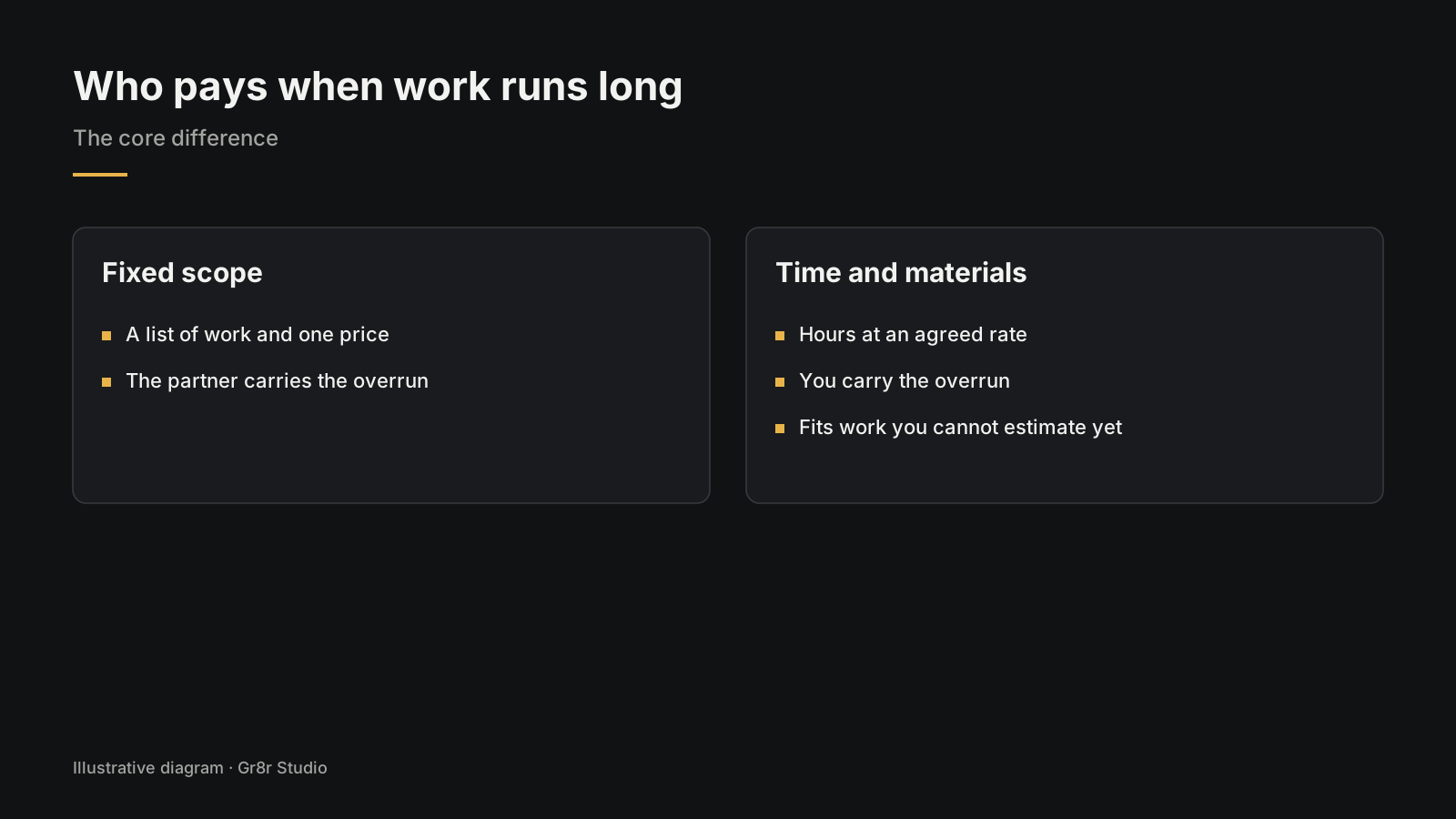
Under a fixed scope contract, you and the partner agree a list of work and one price. Wikipedia's entry on fixed price contracts describes it as one where "the agreed payment amount will not subsequently be adjusted to reflect the resources used, costs incurred or time expended by the contractor" (Wikipedia, Fixed price contract, fetched 25 Oct 2026).
Under time and materials, you pay for the hours worked at an agreed rate. The US Federal Acquisition Regulation says this kind of contract "may be used only when it is not possible at the time of placing the contract to estimate accurately the extent or duration of the work" (FAR 16.601, fetched 25 Oct 2026). That rule was written for government buying, but the logic carries to a startup: you pay by the hour when nobody can honestly say how many hours.
Why do AI builds strain a fixed scope contract?
Because some of the work is an experiment, and you cannot fix the price of an experiment.
A normal app is mostly known work. You can list the screens, the fields and the integrations. An AI feature adds a question nobody can answer on day one: how good is the model on your data? You may find the first approach gets eight answers in ten right, and the ninth needs a second step, a better prompt, or a person in the loop.
Under fixed scope, that discovery turns into a change request. Each change request becomes a small negotiation. The partner protects their margin, you protect your budget, and the product waits.
FAR 16.601 also warns that time and materials "provides no positive profit incentive to the contractor for cost control or labor efficiency." That is the other side of the trade. Neither model is safe on its own. Each needs the right guard rails.
When should you choose fixed scope?
Choose fixed scope when you can write the work on one page and the page will still be true in two months.
Good fits:
- A marketing website with a known set of pages and a chosen platform.
- A set of screens designed from a written list of flows.
- A known integration, such as connecting your app to an accounting system with a documented API.
- A short paid first piece that ends with a defined output, such as a written scope or a clickable prototype.
What to put in the contract: the list of deliverables, what "done" means for each, how many review rounds are included, and how change requests are priced and approved.
When should you choose time and materials?
Choose time and materials when you expect to learn something during the build that will change what you build.
Good fits:
- AI features where accuracy on your data is still unknown.
- A product after launch, where real users tell you what to fix next.
- Work on an existing codebase nobody has fully read yet.
What to put in the contract: an hourly or daily rate, a monthly cap, a weekly demo of working software, and a short report of hours against goals.
Can you mix the two models?
Yes, and for most AI builds we think a mix is the honest answer.
Here is an illustration, not a real client project. A logistics company wants an AI assistant that reads delivery exceptions and drafts a reply. The team could split the work three ways:
- Paid first piece, fixed price. Two weeks to test the model on a sample of real exceptions and design the review screen.
- Fixed scope. The screens, sign in, and the connection to the company's ticket system, all now well defined.
- Time and materials with a cap. Tuning prompts and building the test set until the assistant clears an agreed accuracy bar.
The known work gets a known price. The unknown work gets a meter and a ceiling.
How do you protect yourself under either model?
Ask for working software on a steady rhythm. The Agile Manifesto values "Customer collaboration over contract negotiation" (Manifesto for Agile Software Development, 2001, fetched 25 Oct 2026). A contract still matters. Weekly demos make sure it is not the only thing that does.
| Protection | Fixed scope | Time and materials |
|---|---|---|
| Weekly demo of working software | Yes | Yes |
| Written definition of done | For every deliverable | For every goal |
| Change request process | Priced and approved in writing | Not needed, but log decisions |
| Spending cap | Built in | Agree a monthly cap |
| Ownership of code, designs, prompts and test sets | In writing, yours once paid | In writing, yours once paid |
| Exit clause | Pay for work done to date | Pay for hours worked to date |
At Gr8r, clients own everything once it's paid for, under either model. For questions to raise before you sign, see 15 questions to ask before you sign a dev partner. For what moves the budget itself, see what drives the cost of an AI app.
Which model should you pick this week?
Write your brief, then mark each line as known or unknown. Known lines go fixed. Unknown lines go time and materials with a cap. If most lines are unknown, start with a short paid first piece and decide after. A product discovery phase is one way to run that first piece. Our engagement options are at.
Frequently asked questions
What is the difference between fixed scope and time and materials?
Under fixed scope you agree a price for a defined piece of work, and the price does not change with the hours spent. Under time and materials you pay for the hours actually worked, so the bill follows the effort. Fixed scope moves the risk of overrun to the partner; time and materials keeps it with you.
Which model is better for an AI build?
In our view, time and materials usually fits the part of an AI build where you are still learning how well the model handles your data. Fixed scope fits the parts you can describe in full, such as a set of screens or a known integration. Many builds mix the two.
Is fixed scope cheaper?
Not by default. A partner who carries the risk of overrun usually prices that risk into the quote. Fixed scope gives you a known number, not a smaller one.
How do you stop time and materials from running over?
Ask for a monthly cap, a weekly demo of working software, and a short written report of hours against goals. If a demo shows no visible progress two weeks running, stop and talk.
Can you switch models partway through?
Yes. A common path is a short paid first piece, then fixed scope for the parts that became clear, and time and materials for the parts still being learned. Agree in the contract how a switch happens.
About the author
Tanjim Islam is the founder and CEO of Gr8r Studio. He founded the studio in 2023. Here he writes about how Gr8r approaches hiring, product design and AI engineering. More on the About page.
If you want help with this, book a 30 minute call.