

15 Questions to Ask Before Hiring a Software Development Company

Tanjim Islam
Founder & CEO · · 5 min read


Before you sign a software development company, ask fifteen questions across five areas: the problem, the team, how they work, AI in production, and ownership. Listen for specifics. A good answer names people, shows a live screen, or walks through a real process.
This post is the question bank for our guide to hiring an AI engineering partner. If you are still building a shortlist, see how to choose an AI MVP development company.
Why do the questions matter more than the pitch?
A pitch is rehearsed. Answers to your questions are not.
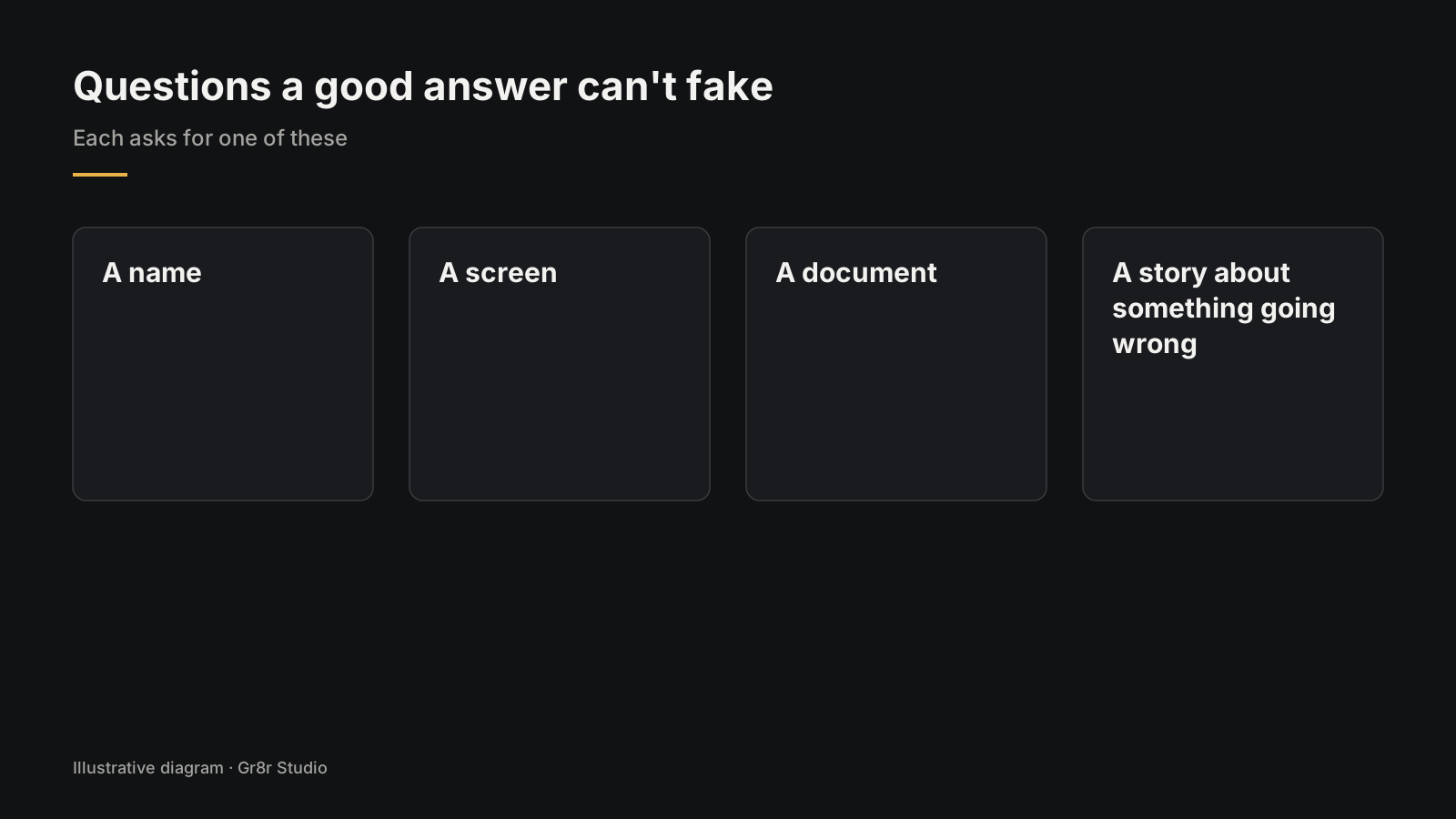
Every company you call will show strong case studies and say they care about quality. The questions below are built so that a good answer is hard to fake. Each one asks for a name, a screen, a document or a story about something going wrong.
Print the list, pick the five that matter most for your project, and keep the rest for the second call.
What should you ask about your problem?
1. What would you want to know about our users? A good answer is a list of questions back to you. A weak answer jumps to features.
2. What would you advise us not to build? A good partner cuts scope. A partner who agrees to everything will agree to the overrun too.
3. What would make this project fail? Listen for honest risks: unclear data, a missing decision maker, a deadline that is too tight.
What should you ask about the team?
4. Who exactly will work on this, and how much of their week is ours? You want names and roles. "Our senior team" is not an answer.
5. Can we talk to the designer and the engineer before we sign? A yes, with a time on the calendar, is the answer you want.
6. What happens if one of them leaves halfway through? Listen for a handover plan and written documentation, not reassurance.
What should you ask about how they work?
7. How often will we see working software? Weekly is a good rhythm. Monthly is too long to catch a wrong turn.
8. Which engagement model do you suggest, and why? A good answer depends on how well your scope is known. See fixed scope or time and materials for your AI build.
9. Can we open three products you designed and built? Open them before the next call. Check first run, the empty state, an error, and the phone view.
What should you ask about AI in production?
Many question lists for software companies stop before the AI. If your product has an AI feature, add these.
10. How do you test AI output before it ships? A good answer describes a set of real examples with known right answers that runs on every change. Ask to see one.
11. Which risks from the OWASP Top 10 for LLM applications apply to us? The 2025 list includes prompt injection, sensitive information disclosure and excessive agency (OWASP GenAI Security Project, LLM Top 10, fetched 25 Oct 2026). A good partner picks the ones that apply and says what they do about each.
12. What does the user see when the AI is unsure or wrong? This is where design and engineering meet. A good answer describes a screen: a low confidence label, a source link, an edit box, an approval step.
What should you ask about ownership and exit?
13. Will the repository, cloud account and domain be in our name from day one? GitHub's documentation notes that when a repository is transferred, "its issues, pull requests, wiki, stars, and watchers are also transferred" (GitHub Docs, Transferring a repository, fetched 25 Oct 2026). Starting in your account means nothing needs transferring later.
14. Do we own the prompts, test sets and model settings, as well as the code? For an AI product, these are part of what you paid for. At Gr8r, clients own everything once it's paid for. A full list to check is in the AI ownership checklist.
15. If we stop after the first month, what do we walk away with? A good answer lists files, documents and working software, not a refund policy.
How do you score the answers?
Score each answer from 1 to 5 right after the call, while you remember it. Use the same card for every company.
| Score | What it sounds like |
|---|---|
| 5 | Specific, with a name, a screen or a document you can check |
| 3 | Reasonable, but general; ask a follow up |
| 1 | Vague, defensive, or a price before a question |
A low score on question 4, 13 or 14 is a reason to stop. The full list of warning signs is in red flags when hiring a software partner. When two companies tie, a short paid first piece decides.
If you want to put Gr8r through these fifteen questions, talk to us.
Frequently asked questions
What should you ask a software development company first?
Ask what they would want to know about your users and your problem. A good partner answers with questions of their own. Then ask what they would advise you not to build, which shows whether they will push back.
How do you check a software company's references?
Ask for live products you can open, and for a client contact on a project like yours. Open the products before the call and click through first run, empty, error and mobile screens. Ask the reference what went wrong and how the team handled it.
Who should own the code after the project?
You should. The contract should say code, designs, prompts, test sets, data and accounts belong to you once paid for, with the repository and cloud accounts in your name from day one.
How many questions should you ask on one call?
Fewer than you think. Pick five that matter most for your project, ask them on the first call, and save the rest for a second call with the people who will do the work.
How do you compare answers from different companies?
Write each answer down right after the call and score it from 1 to 5 against the same question. Compare the scores side by side, and use a short paid first piece to break a tie.
About the author
Tanjim Islam is the founder and CEO of Gr8r Studio. He founded the studio in 2023. Here he writes about how Gr8r approaches hiring, product design and AI engineering. More on the About page.
If you ask a partner for a sample of their written work, this is the kind of thing to expect: our UX audit of Veluno, a product we built and reviewed the way we review client products. Built by Gr8r for its own portfolio. Not client work.
If you want help with this, book a 30 minute call.