

How to Choose an AI MVP Development Company

Tanjim Islam
Founder & CEO · · 6 min read


This guide is the MVP specific part of our main guide on how to hire an AI engineering partner. Read that for the full process. Read this when the thing you need is a first version with AI inside.
Why is choosing an AI MVP partner different?
Because an AI first version can look finished and still be wrong.
A normal MVP either works or breaks where you can see it. A button does nothing, a page will not load. An AI feature can produce a confident, tidy, wrong answer. A partner who demos well but does not test the AI will hand you a product that fails quietly in front of your first customers.
So the usual checks, portfolio and price and speed, are not enough. You need to see how a partner thinks about the parts that guess.
What should you send partners before the first call?
One page. The same page to every partner, so you can compare answers side by side.
- The one job. "A [user] uses this to [job] instead of [what they do today]."
- The data. What records exist, where they live, and how messy they are.
- Who approves. Which actions a person must sign off before anything happens.
- The deadline and why. A demo day, a fundraise, a pilot customer.
- What you already have. Designs, a prototype, an AI built draft.
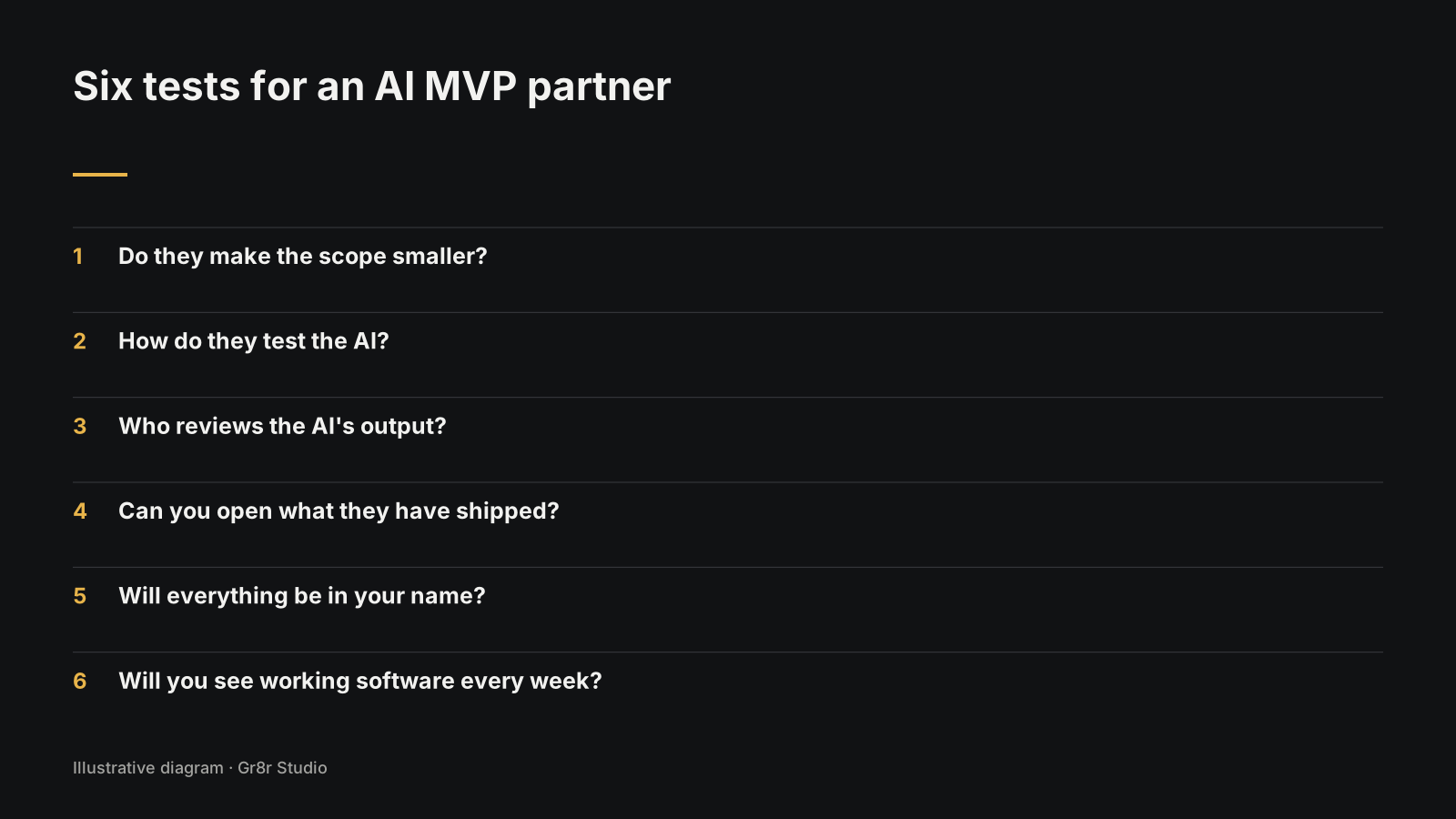
What are the six tests for an AI MVP partner?
1. Do they make the scope smaller?
A good partner restates your idea as one user doing one job. They ask what can wait. If every feature you mention gets a yes, you will get a long build and a late launch.
Ask: "What would you cut from this brief, and why?"
2. How do they test the AI?
Listen for a test set: real examples with known good answers, rerun every time a prompt or model changes. Anthropic's engineering team advises builders to "Start with simple prompts, optimize them with comprehensive evaluation" (Anthropic, Building effective agents, 19 Dec 2024, fetched 25 Oct 2026). A partner who cannot describe their testing in plain words has not done much of it.
Ask: "How will we know the AI is right often enough to launch?"
3. Who reviews the AI's output?
Some actions should never happen without a person. OpenAI's guide to building agents says high risk actions "should trigger human oversight until confidence in the agent's reliability grows" (OpenAI, A practical guide to building agents, fetched 25 Oct 2026). A good partner designs those review screens from the start. See designing the review step before an AI agent acts.
Ask: "Show me a review or approval screen you have designed."
4. Can you open what they have shipped?
Slides are not proof. Ask for live products you can click, and ask which parts the partner actually built. If the work is under NDA, ask for a walkthrough on a call.
Ask: "Which of these did you build end to end, and what did you leave out of the first version?"
5. Will everything be in your name?
Code, design files, prompts, the test set, and the cloud and model accounts. Ownership should be written into the contract, and a lawyer should read it. Our AI ownership checklist lists every asset to cover.
Ask: "Whose name will the repository and model accounts be in on day one?"
6. Will you see working software every week?
A weekly demo with written decisions after it. Not a launch date with silence in between. What the first two weeks should look like is in your first two weeks with a new product partner.
Ask: "What will I be able to click by the end of week two?"
How do you compare partners side by side?
Score each reply from 1 to 3 on each test. A 1 means vague, a 3 means specific and written down. Do not add up price yet. Compare scope first, then price.
What warning signs should end the conversation?
Walk away if there's no live work to open, testing is left for later, accounts sit in the partner's name, nothing is written as out of scope, or you see nothing until the end.
- No live work you can open.
- "We will figure out testing during development."
- Accounts in the partner's name.
- No written list of what is out of scope.
- Nothing to see until the end.
The full list is in 9 red flags when hiring a software development company.
How do you decide between two good partners?
Pick the one that asked better questions about your users and your data. The team that asks about the messy spreadsheet and the person who approves refunds is more likely to have shipped real AI before.
Here is an illustration, not a real client story. Two partners reply to the same brief for an AI tool that drafts replies to supplier emails. One sends a feature list and a timeline. The other sends three questions: how many emails a day, which replies must a person approve, and can they see twenty real examples. The second reply is the one to call back.
Then check the engagement model. Fixed scope or time and materials changes how scope changes get handled.
Where does Gr8r fit?
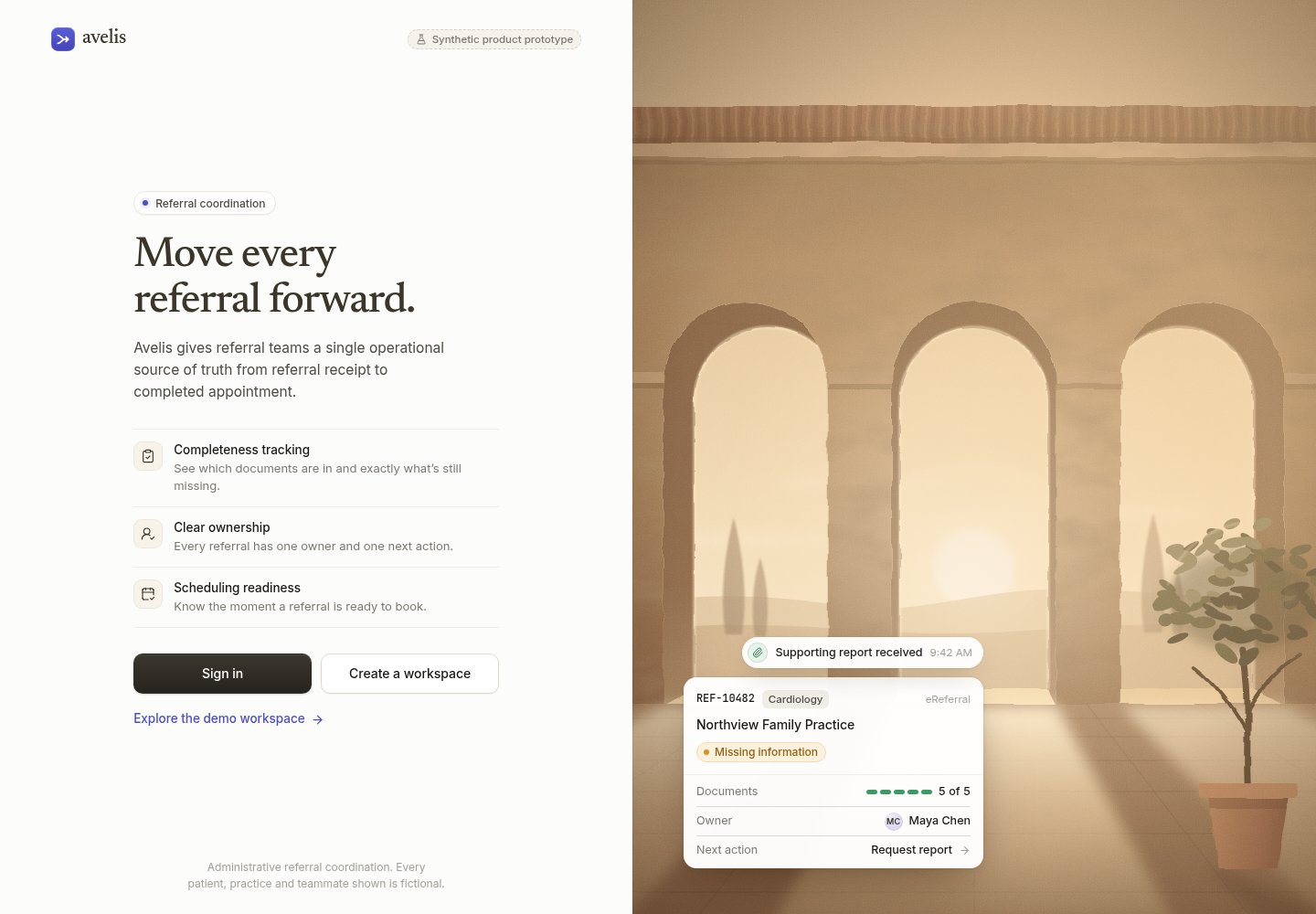
You can judge our work the same way. Avelis, a referral coordination product, labels itself "Synthetic product prototype" on its first screen and lets you explore a demo workspace. Built by Gr8r for its own portfolio. Not client work.
We would rather you run this process with us in it than pick on trust. Clients own everything once it's paid for. See MVP development or talk to us.
Frequently asked questions
How do I choose an AI MVP development company?
Send the same short brief to two or three partners and score their replies on scope, AI testing, human review, shipped work, ownership and weekly demos. Pick the one whose answers are specific and written down.
What should I ask an AI MVP development company?
Ask how they would narrow your idea to one workflow, how they test AI output, who approves its actions, what they have shipped that you can open, whose name the accounts will be in and how often you will see working software.
What are red flags when hiring an MVP developer?
Vague answers on testing, no live work you can open, accounts in their name, no written cut list, and no demo until the end. Any one of these is worth a hard question.
How long should an AI MVP take?
It depends on scope, the systems involved and how fast decisions are made. Ask each partner for a plan with a working demo every week, so you can see progress instead of waiting for a launch date.
Should I own the code from an MVP partner?
Yes. Make sure the contract says you own the code, prompts, test set and designs once paid for, and that accounts are in your name. At Gr8r, clients own everything once it's paid for.
Next step
Task Management, a project workspace Gr8r built, is another one you can click through: a home screen with counters for active projects, open tasks and overdue work, plus a project progress table. Built by Gr8r for its own portfolio. Not client work. It runs on demo data, so it shows the screens, not results.
If you want help with this, book a 30 minute call.
About the author
Tanjim Islam is the founder and CEO of Gr8r Studio. He founded the studio in 2023. Here he writes about how Gr8r approaches hiring, product design and AI engineering. More on the About page.