

This post is the definition and nothing more: what an MVP is, what goes in, what stays out, and how it differs from a prototype, a v1 and a proof of concept. For real first versions you can open, see our MVP examples.
What does MVP mean in software development?
MVP stands for minimum viable product. An MVP is the smallest working version of a product that real users can use to do one job, built so the team can learn whether people want it.
The term was coined by Frank Robinson in 2001 and made popular by Steve Blank and Eric Ries, author of The Lean Startup. Ries's definition, written in 2009: "the minimum viable product is that version of a new product which allows a team to collect the maximum amount of validated learning about customers with the least effort" (Eric Ries, Minimum Viable Product: a guide, Startup Lessons Learned, 3 Aug 2009, fetched 25 Oct 2026).
Atlassian puts it in product terms: "the most basic version of a product that includes only the core features necessary to satisfy early adopters and validate a product idea in the market" (Atlassian, What is a Minimum Viable Product (MVP)?, page date not shown, fetched 25 Oct 2026).
Michael Seibel of Y Combinator is blunter: "This is the first thing you can give to the very first set of users you wanna target, in order to see if you can deliver any value at all to them. That's all it is" (Y Combinator, How to plan an MVP, Michael Seibel, page date not shown, fetched 25 Oct 2026).
What do the three words actually mean?
Each word does a job. Picture a food truck before a restaurant.
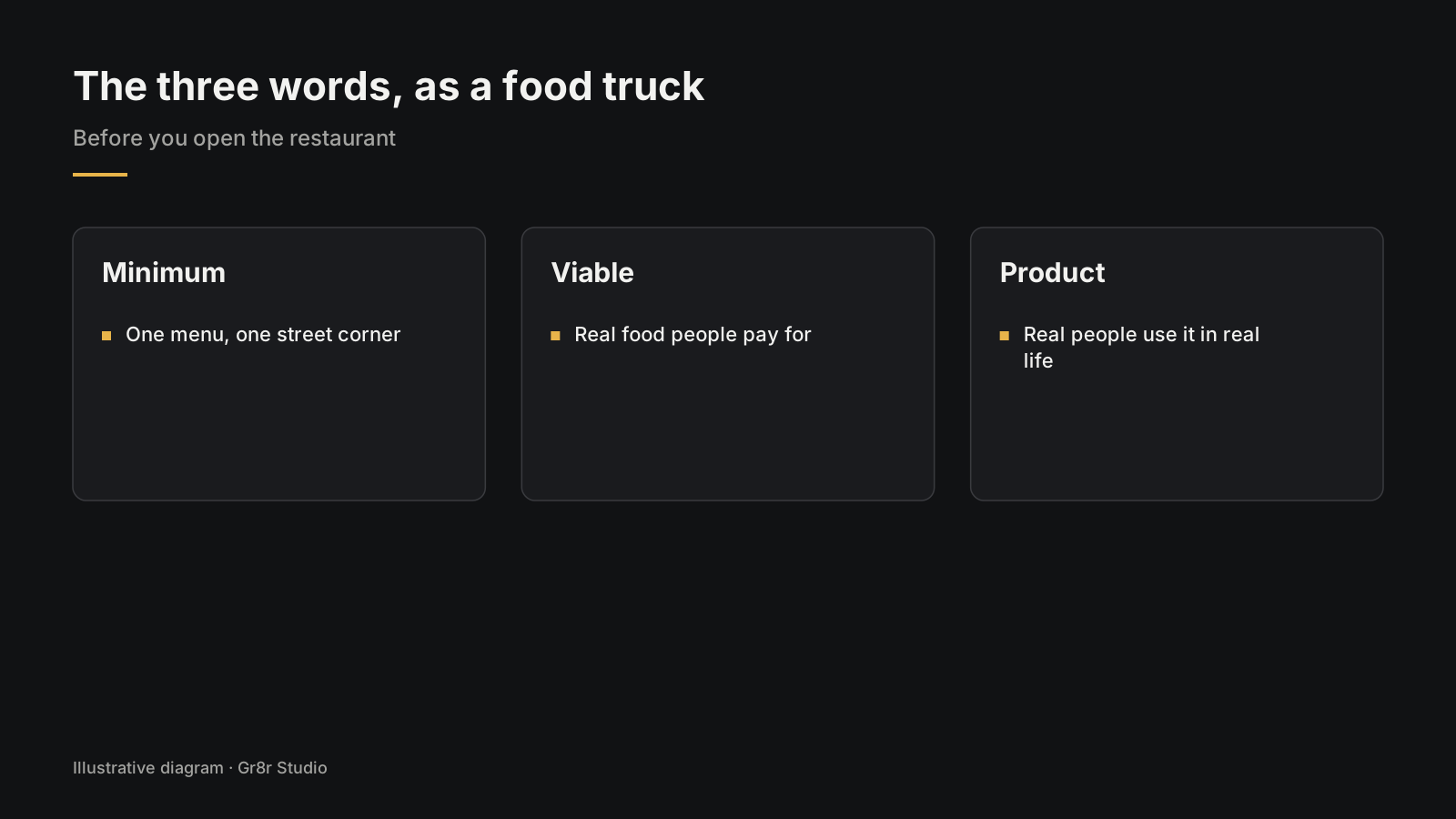
- Minimum. One menu, one street corner. Only what is needed for the one job.
- Viable. The food is real and people pay for it. It works from start to finish, not just on a poster.
- Product. Real people use it in real life, not a sketch in a meeting room.
Ries warns that the word minimum misleads people: "MVP, despite the name, is not about creating minimal products." The point is learning. He also says it "requires judgment to figure out, for any given context, what MVP makes sense." There is no fixed feature count.
What goes into an MVP, and what stays out?
In:
- The one job a user comes to do, working from start to finish.
- Enough sign in and data safety that real people can trust it with real work.
- A way to see what users do: basic analytics, or simply talking to them.
Out, for now:
- Second and third user types.
- Settings, themes and nice to have screens.
- Automations for edge cases a person can handle by hand.
- Features users asked for but no one has shown they need.
Seibel gives a sharp example. Airbnb's first product had "no payments" and "no map view." Guests paid hosts in person. It still let people find a room and stay in it. That was the one job.
Our own Sticker Studio works the same way. Its first screen says "Image in, sticker out": upload a photo, the background comes off, and a die-cut outline wraps the subject. Built by Gr8r for its own portfolio. Not client work.
He also offers a planning trick: "time box your spec." Pick a launch date, then keep only what fits before it. How to turn that into a full scope for a funded SaaS team is in our SaaS MVP product design guide.
How is an MVP different from a prototype, a v1 and a proof of concept?
These four get mixed up all the time. The fastest way to tell them apart is to ask what question each one answers.
| Answers the question | Who uses it | Does it work? | |
|---|---|---|---|
| Proof of concept | Can this be built at all? | Your own team | Only the risky part |
| Prototype | Does this make sense to people? | Testers, often in a session | Looks real, mostly fake underneath |
| MVP | Will people actually use this for the job? | Real early users | Yes, for one job, end to end |
| v1 | Can we sell and support this at scale? | Paying customers | Yes, with polish and support |
Atlassian draws the PoC line the same way: an MVP is "released to gather customer feedback and validate market demand, while a PoC (Proof of Concept) is a prototype or experiment to test if an idea or technology is feasible." It adds that "MVPs are tested with real users, whereas PoCs are usually internal."
Here is an illustration, not a real client. A team wants an app that turns a photo of a paper receipt into an expense report.
- Proof of concept: a script that reads 50 receipt photos and checks whether the totals come out right. No screens.
- Prototype: clickable screens in a design tool. Testers tap through a fake upload and a fake report.
- MVP: a real app for one team. Snap, check, export to a spreadsheet. Nothing else.
- v1: the same app with company accounts, approvals, billing and a help center, sold to paying customers.
Is an MVP just a cheap, unfinished product?
No. Cheap and unfinished is a byproduct, not the goal. An MVP is unfinished on purpose, in the places that do not matter yet, and finished in the one place that does.
An app that has twelve half working features is not an MVP. It cannot teach you anything, because users fail before they reach the job. An app with one feature that works well can.
Ries also points out that an MVP is "quite annoying, because it imposes extra overhead." You have to talk to users and read the numbers, or you have built a small product and learned nothing.
How do you know your MVP worked?
You can answer the question you built it to answer. Seibel's version: "Does it solve the problem I want it to solve? That's it." He adds that you can often see it in behaviour. If the problem happens every day, do users come back the next day?
Write the question down before you build. "Will clinic staff log referrals here instead of in a spreadsheet?" "Will a finance team export from this every week?" If you cannot write the question, you are not ready to define the MVP.
What should you read next?
Three guides go deeper:
- Real first versions with their cut lists: MVP examples.
- What sets the timeline: how long an MVP takes.
- Scoping and designing a SaaS first version: SaaS MVP product design guide.
If you want a team to build yours, see MVP development.
Frequently asked questions
What does MVP stand for in software development?
MVP stands for minimum viable product. It is the smallest working version of a product that real users can use to do one job, built so the team can learn whether people want it.
What is the difference between an MVP and a prototype?
A prototype shows how a product might look and feel, often with fake data underneath, and is tested in sessions. An MVP works for real: early users use it to do a real job, end to end.
What is the difference between an MVP and a proof of concept?
A proof of concept tests whether something can be built at all and usually stays inside the team. An MVP is released to real users to learn whether they want it.
Is an MVP the same as version 1?
No. An MVP is built to learn whether people will use the product for one job. Version 1 is built to sell and support at scale, with polish, billing and help that an MVP can leave out.
Who came up with the term minimum viable product?
Frank Robinson coined it in 2001, and Eric Ries, author of The Lean Startup, made it popular. In 2009 Ries defined it as the version of a new product that collects the maximum validated learning about customers with the least effort.
About the author
Tanjim Islam is the founder and CEO of Gr8r Studio. He founded the studio in 2023. Here he writes about how Gr8r approaches hiring, product design and AI engineering. More on the About page.
If you want help with this, book a 30 minute call.
Related reading
- Sticker Studio, built by Gr8r for its own portfolio
- MVP examples
- how long an MVP takes
- SaaS MVP product design guide
- what product discovery is
- MVP development
- talk to us