

What Drives the Cost and Timeline of an MVP

Tanjim Islam
Founder & CEO · · 6 min read


This post does not give you a price. It explains what moves the price and the timeline, so you can read any quote with clear eyes. If your product is AI first, our post on AI app development cost covers the extra drivers.
Why is there no single answer to MVP cost?
Because "MVP" describes a goal, not a size. One founder's MVP is a single form and a dashboard. Another's is a two sided marketplace with payments and a mobile app.
Estimates made this early are also unreliable by nature. Steve McConnell's research on the Cone of Uncertainty found that "estimates created at Initial Concept time can be inaccurate by a factor of 4x on the high side or 4x on the low side," a 16x range from top to bottom (Construx, The Cone of Uncertainty, fetched 25 Oct 2026).
So when two quotes for "the same MVP" differ by a lot, they are often quoting two different products.
What are the seven drivers of MVP cost and time?
Seven drivers set the cost and timeline: core flows, platforms, integrations, data and roles, AI features, design polish and decision speed.
| Driver | Pushes cost and time up when | Keeps it down when |
|---|---|---|
| 1. Core flows | Many user journeys at launch | One journey that proves the idea |
| 2. Platforms | Web, iOS and Android at once | One platform first |
| 3. Integrations | Custom or poorly documented APIs | Well known services with good docs |
| 4. Data and roles | Many user types, permissions, reports | One user type, simple data |
| 5. AI features | Custom models, agents, heavy testing | One model call with a human check |
| 6. Design polish | Custom brand, motion, many states | A clean system, few screens |
| 7. Decision speed | Slow feedback, many approvers | One decision maker, fast replies |
How do core flows change the cost?
A core flow is one thing a user comes to do from start to finish, such as "sign up and book a session" or "upload a file and get a report". Each flow brings its own screens, empty states, errors and tests.
This is the biggest driver, and the easiest to cut. Ask: which single flow, if it works, proves people want this? Build that one well. Write the others on a "later" list.
Do platforms really matter that much?
Yes. Each platform is more code to write, test and maintain. Mobile also adds store costs and wait time. Apple's Developer Program is a "$99 annual membership" (Apple Developer Program, fetched 25 Oct 2026), and each release goes through app review.
A responsive web app works in every phone's browser. Many MVPs start there and go native once usage proves the need.
Why do integrations surprise people?
Because the effort is in someone else's system. A well documented service with a test mode is quick to connect. An old internal system with no docs can take longer than the rest of the app.
Use standard services where you can. Payments are a good example. Stripe charges "2.9% + 30¢ per successful transaction for domestic cards" on its standard plan (Stripe pricing, fetched 25 Oct 2026). That is a running cost, but it saves you building and securing payments yourself.
List every system the MVP must talk to before asking for a quote. It changes the estimate a lot.
How do data and user roles add work?
Every new user type multiplies screens and rules. An app with "customer" only is simple. Add "admin", "team member" and "manager" and each screen needs to know who can see and change what.
Reports and exports add up too. Ask whether a spreadsheet export would do for version one instead of a built in dashboard.
What do AI features add?
An AI feature adds work you can't see on the screen: writing and testing prompts, handling wrong answers, adding a human check, and paying for each model call. An agent that acts on its own adds more, because every action needs limits and logs.
Keep MVP AI narrow. One model call with a person reviewing the output proves the idea. The full breakdown sits in our AI app development cost post.
How much does design polish change things?
Clean and clear is enough to test demand. Custom illustration, motion and many edge states are worth it when the product sells on feel, such as in consumer apps. For a B2B tool that saves time, clarity matters more than flair.
Why does decision speed change the timeline?
Because the team waits while you decide. A build where one person answers questions the same day moves faster than one where every screen needs three approvals over a week.
McConnell makes the point directly: "The Cone narrows only as you make decisions that eliminate variability." And he notes that a significant narrowing of the Cone happens during the first 20 to 30% of the total calendar time. In plain terms, early decisions are worth the most.
How do you shrink the range before you sign?
Do these five things before you ask anyone for a number.
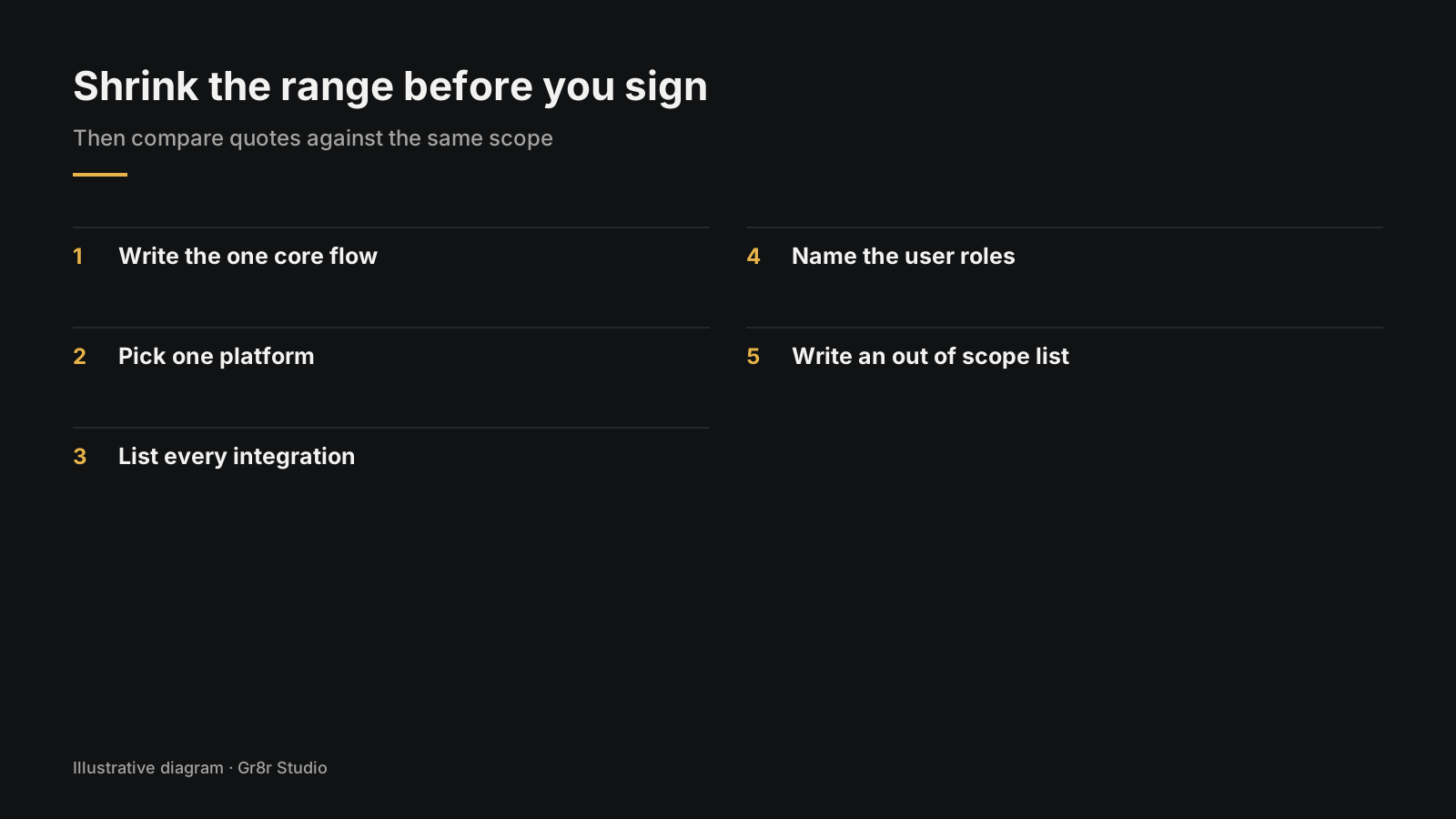
- Write the one core flow as steps a user takes.
- Pick one platform and say why.
- List every integration with a link to its docs.
- Name the user roles and what each can do.
- Write an "out of scope" list. It matters as much as the in scope list.
Then compare quotes against the same written scope. A short discovery phase is the usual way to get there. What happens in the first weeks with a dev partner shows what that looks like.
What should you take away?
Do not ask "how much does an MVP cost?" Ask "how much does this scope cost?" The seven drivers tell you where the money and time go. Decide early, cut hard, and get quotes that compare like with like.
Frequently asked questions
How much does it cost to build an MVP?
It depends on scope, platforms, integrations, AI features, design polish and how fast decisions get made. Any single number quoted before those are decided is a guess. Narrow the scope first, then ask for quotes.
Why do MVP quotes vary so much?
Because each team is guessing at a different version of your product. Research from Construx shows estimates made at the idea stage can be off by four times either way. Clear scope makes quotes comparable.
What makes an MVP take longer?
Slow decisions, unclear scope, extra platforms, third party integrations, app store review and new requirements added mid build. Decision speed is the one founders control most directly.
Is a mobile MVP more expensive than a web MVP?
Usually it is more work, because you may build for two platforms, pay store fees and wait for app reviews. Apple charges 99 USD a year for its developer program. A web app reaches both kinds of phone through the browser.
How do I reduce the cost of my MVP?
Cut to one core flow, one platform and the fewest integrations that prove the idea. Use off the shelf services for payments and login. Make decisions quickly, and agree what is out of scope in writing.
About the author
Tanjim Islam is the founder and CEO of Gr8r Studio. He founded the studio in 2023. Here he writes about how Gr8r approaches hiring, product design and AI engineering. More on the About page.
If you want help with this, book a 30 minute call.