

The AI Ownership Checklist: Code, Prompts, Data and Accounts

Tanjim Islam
Founder & CEO · · 5 min read


This is a checklist, not legal advice. Use it to ask better questions, then have a lawyer read your contract. It fits into our guide on hiring an AI engineering partner.
Why is ownership harder with an AI build?
Because an AI build leaves more things behind than code.
A normal app leaves you a repository, some design files and a hosting account. An AI build adds prompts, a test set of real examples with good answers, evaluation results, model provider accounts with API keys, and often a store of your documents prepared for search. Each one is an asset. Each one can end up in the wrong name.
Here is an illustration, not a real client story. A founder wants to switch partners. The code is in her GitHub, but the model account, the keys and the test set live in the old partner's workspace. The app runs. She cannot change it without rebuilding the parts she thought she had bought.
What does the law say by default?
We are not lawyers, and the rules differ by country. Two official pages are worth reading yourself.
The UK Intellectual Property Office says: "When you ask or commission another person or organisation to create a copyright work for you, the first legal owner of copyright is the person or organisation that created the work and not you the commissioner, unless you otherwise agree it in writing" (UK IPO, Ownership of copyright works, published 19 Aug 2014, fetched 25 Oct 2026).
In the US, the Copyright Office explains that a commissioned work is a "work made for hire" only if it falls into one of nine listed categories and there is a signed written agreement. "If a work fails to satisfy any of these requirements, it is not a work made for hire" (US Copyright Office, Circular 30, revised Aug 2024, fetched 25 Oct 2026).
What this means for you in practice: do not assume. Read what your contract says about ownership, and ask a lawyer whether it does what you think.
What should the ownership checklist cover?
Five groups. Tick each one before you sign, and again at handover.
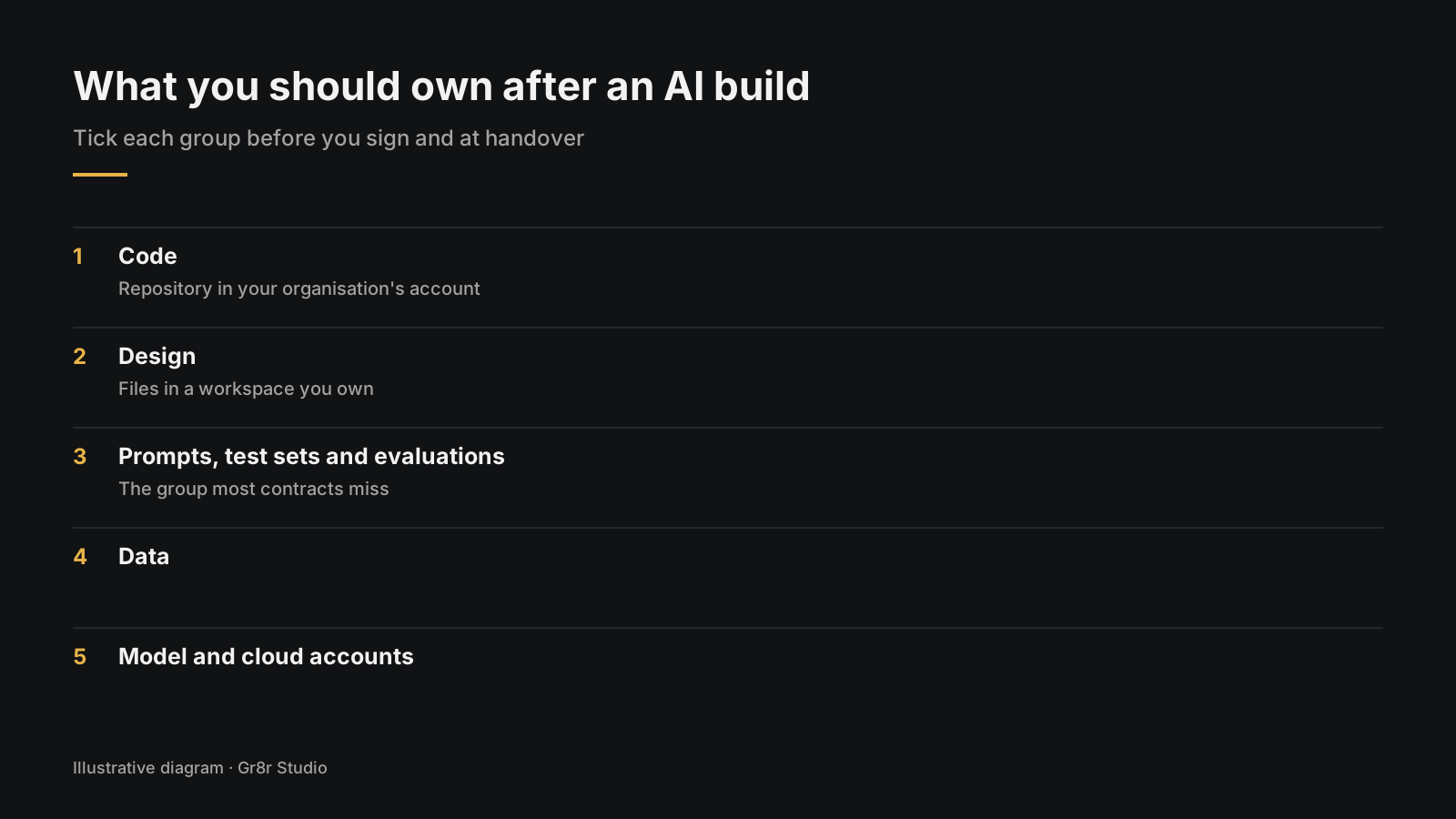
1. Code
- The repository lives in your organisation's account, with the partner invited.
- Infrastructure setup, scripts and documentation are in that repository.
- The contract names the code as a deliverable you own once paid.
2. Design
- Design files live in a workspace you own.
- The design system and any brand assets made for you are listed as deliverables.
3. Prompts, test sets and evaluations
This is the group most contracts miss.
- System prompts and prompt templates are stored in your repository, not in a partner tool.
- The test set, the real examples with known good answers, is a named deliverable.
- Evaluation results and scripts come with it, so a new team can rerun them.
4. Data
- Your source data stays yours. The contract says what the partner may and may not do with it.
- Any processed copies, such as documents split up for search, are listed and handed over.
- Logs of what the AI did are kept in your systems.
5. Model and cloud accounts
- Model provider accounts and API keys are in your name and on your card.
- Cloud hosting, domain and analytics accounts are in your name.
- The partner works through invited access you can remove.
What about the partner's own tools and libraries?
Most partners reuse code they owned before your project: starter kits, internal tools, open source libraries. That is normal. One law firm's overview of service agreements lists the supplier's "background IP" as something the supplier keeps under a traditional ownership structure (Morgan Lewis, Nov 2024, fetched 25 Oct 2026).
The question to ask is simple: if this partner disappeared tomorrow, could we keep running and changing the product? If reused code is in the build, you want a lasting right to use it. Your lawyer can tell you how the contract should say that.
Can AI generated code be owned at all?
That is a live legal question. The US Copyright Office has published a multi part report on copyright and AI, with Part 2 on the copyrightability of AI outputs published on 29 Jan 2025 (US Copyright Office, Copyright and Artificial Intelligence, fetched 25 Oct 2026). If much of your code is machine written, ask your lawyer what that means for you.
For the contract itself, the practical step is the same: make sure whatever rights exist pass to you.
What should you ask a partner before you sign?
Ask whose name the accounts are in, whether prompts and test sets are deliverables, what rights you get to reused code, what happens to your data if you part ways, and when ownership passes to you.
- Whose name will the repository, cloud and model accounts be in on day one?
- Are prompts, test sets and evaluation results listed as deliverables?
- What reused code or tools will be in the build, and what right do we get to them?
- What happens to our data and logs if we part ways?
- When does ownership pass to us, and is that written in the contract?
More questions are in 15 questions to ask before hiring a software development company.
What is Gr8r's position?
At Gr8r, clients own everything once it's paid for. Even so, have your own lawyer read any contract you sign, ours included. To see how we work, read about our AI software development, or talk to us.
Frequently asked questions
Who owns the code when you hire a software development company?
It depends on the contract. Official US and UK guidance says the creator usually owns a commissioned work first unless a written agreement says otherwise. Have a lawyer check that your contract transfers ownership to you.
Does paying for software mean I own it?
Not on its own. Payment and ownership are separate questions. Ownership usually passes through a written term in the contract, which is why a lawyer should read it before you sign.
Who owns the prompts and test set in an AI build?
Whoever the contract says. Name prompts, test sets and evaluation results in the list of deliverables, so there is no doubt they are covered.
Should model and cloud accounts be in my name?
Yes, where you can. Accounts in your name from day one mean nothing needs moving later, and you control the bills, the keys and the data.
Does Gr8r give clients ownership?
Yes. At Gr8r, clients own everything once it's paid for. You should still have your own lawyer read any contract you sign, with us or anyone else.
Next step
If you want help with this, book a 30 minute call.
About the author
Tanjim Islam is the founder and CEO of Gr8r Studio. He founded the studio in 2023. Here he writes about how Gr8r approaches hiring, product design and AI engineering. More on the About page.