

What Is a UX Audit, and What Do You Get at the End?

Tanjim Islam
Founder & CEO · · 6 min read


This post answers the question in plain words, shows how an audit of a website works, and lists what you should be holding when it is done. If you want one done for you, Gr8r offers a free UX audit to the first 5 companies that ask.
What is a UX audit, in one paragraph?
A UX audit is an expert review of a website or app that already exists. Someone who knows usability walks through the tasks your users care about, checks each screen against proven rules and your own data, and writes down every place where people slow down, get confused or give up. Each problem gets a severity score. The audit ends with a plan that says what to fix first.
Most definitions that rank today say the same thing in different words. Shopify calls it "a methodical evaluation of a digital product or service to assess its usability, accessibility, and overall user satisfaction" (Shopify, Ecommerce UX audit, fetched 25 Oct 2026). Baymard describes "a structured evaluation of your website or app, designed to uncover usability issues that may be hurting performance" (Baymard, What Is a UX Audit?, fetched 25 Oct 2026).
The part buyers forget is the ending. An audit is not a list of opinions. It is a ranked list with a plan attached.
What do you get at the end of a UX audit?
Three things. If one is missing, ask for it.
- A short report. One or two pages up front that say what was reviewed, the three to five problems that matter most, and the direction: small fixes, a rework of one flow, or a redesign.
- Severity ranked findings. Every problem written as a card: the screen, a screenshot with the problem circled, what the user experiences, the rule it breaks, and a severity score.
- A fix plan. The findings sorted into an order of work, so your designer and engineer know what to pick up on Monday.
For the full layout of each page, see our UX audit report template.
How is a UX audit different from usability testing?
Usability testing watches real people try real tasks. A UX audit is an expert review. Nobody is recruited, nobody is paid to sit in a session.
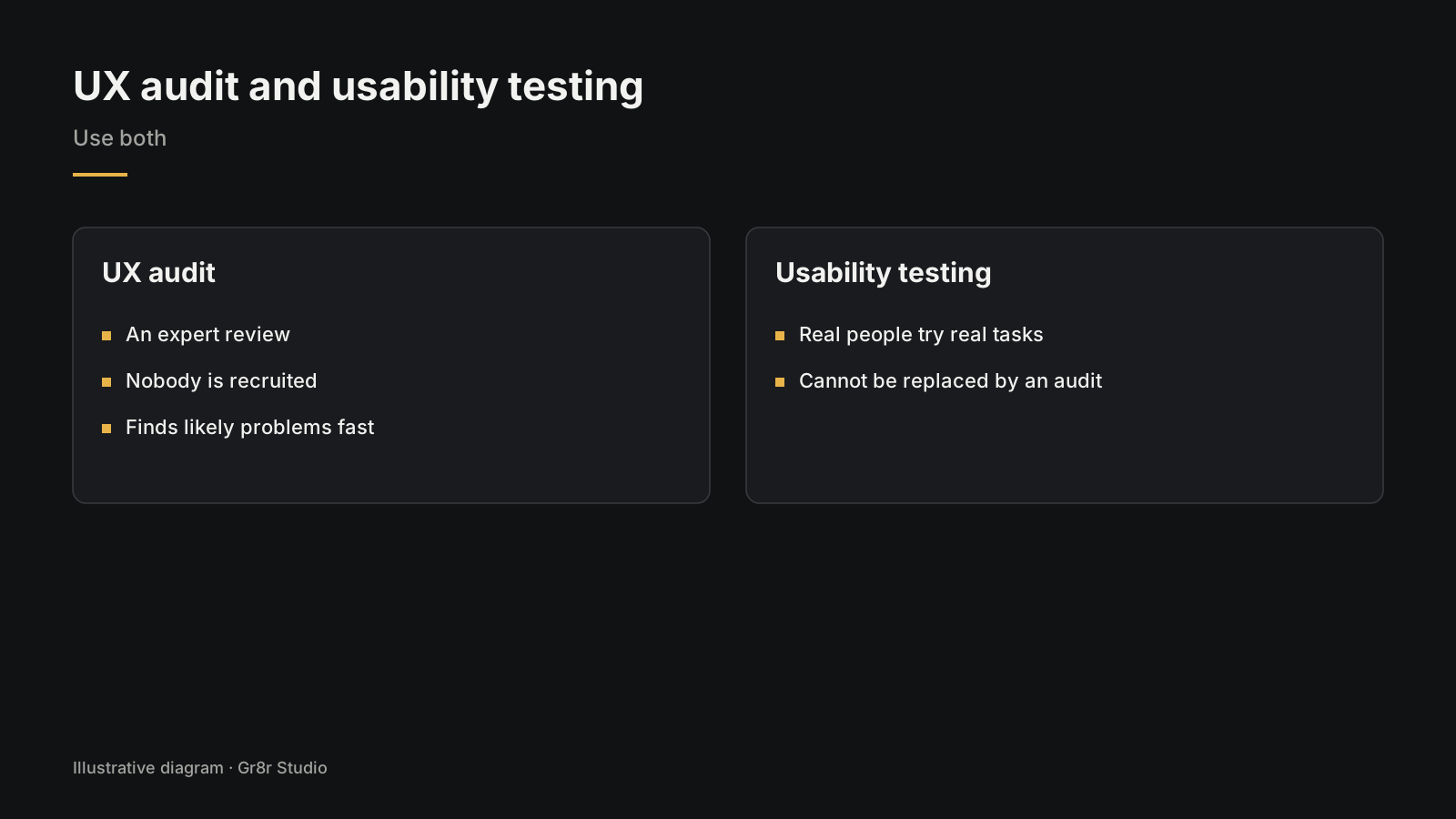
The Nielsen Norman Group puts it plainly. A heuristic evaluation is "a method for identifying design problems in a user interface," and it helps "find likely issues without having to test with participants." In the same article: "heuristic evaluations cannot replace user research" (NN/g, How to Conduct a Heuristic Evaluation, 25 June 2023, fetched 25 Oct 2026).
So use both. The audit finds the likely problems fast. A small test then confirms the big ones before you spend money fixing them.
How do you do a UX audit of a website?
Pick the tasks users must complete, set the severity rules, walk each task while noting friction, then write findings with a fix for each. For the full step by step method, see how to do a website UX audit.
How are UX audit findings ranked?
By severity. A common scale comes from Jakob Nielsen, published in 1994 and still in use:
| Score | Meaning |
|---|---|
| 0 | I don't agree that this is a usability problem at all |
| 1 | Cosmetic only, fix if there is spare time |
| 2 | Minor, low priority |
| 3 | Major, high priority |
| 4 | Catastrophe, fix before release |
Nielsen says severity is "a combination of three factors": how often the problem happens, how hard it is to get past, and whether it keeps bothering people every time (NN/g, Severity Ratings for Usability Problems, 1 November 1994, fetched 25 Oct 2026). He also warns that "severity ratings from a single evaluator are too unreliable to be trusted."
Here is an illustration, not a real client. A booking site's date picker opens behind the phone keyboard. Every mobile visitor hits it, it blocks the booking, and it happens on every visit. That is a 4. The footer uses two shades of grey for links. Annoying, but nobody is stopped. That is a 1.
When should you get a UX audit?
Good moments:
- Before a redesign, so you keep what works and fix what does not.
- When a number drops and nobody can say why: sign ups, checkouts, demo bookings.
- Before a fundraise or launch, when investors or first customers will click through.
- After a fast build, when screens were added in a hurry and never reviewed together.
A bad moment is when you have already decided on a full redesign and want a report to justify it. An honest audit may tell you three fixes are enough.
What should a good UX audit never do?
A good audit never grades by taste, hands you an unranked pile of problems, skips the evidence, or leaves accessibility out.
- Grade by taste. "I don't like the font" is not a finding. A finding names the rule broken and the user who suffers.
- Hand you 80 problems with no order. A list without ranks is homework, not a plan.
- Skip the evidence. Every card needs a screenshot and a reason.
- Ignore accessibility. Contrast, keyboard use and screen reader labels belong in scope.
How do you get a free UX audit from Gr8r?
Gr8r offers a free UX audit to the first 5 companies that ask. The service page explains how to ask for one.
Frequently asked questions
What are UX audits?
A UX audit is an expert review of an existing website or app against usability principles and your own data. It finds where people get stuck, ranks each problem by severity, and ends with a written fix plan.
How do you do a UX audit of a website?
Pick two to four key tasks, gather your analytics and support tickets, walk each task on real devices, check every screen against a set of usability heuristics, rate each problem by severity, and write a report with a ranked fix plan.
What is the difference between a UX audit and usability testing?
Usability testing watches real users try tasks. A UX audit is an expert review that does not need participants. The two work well together: the audit finds likely problems, and testing confirms the big ones.
How long does a UX audit take?
It depends on scope. One checkout flow on one device is a small job. A whole product across mobile and desktop is a large one. Agree the tasks and devices first, then the timeline.
Does Gr8r offer a free UX audit?
Yes, for the first 5 companies that ask. The UX audit page explains how to request one.
About the author
Tanjim Islam is the founder and CEO of Gr8r Studio. He founded the studio in 2023. Here he writes about how Gr8r approaches hiring, product design and AI engineering. More on the About page.
For a real example, read our UX audit of Veluno. We audited a product we built at three screen widths, by mouse and by keyboard, and found 13 issues. Built by Gr8r for its own portfolio. Not client work.
If you want help with this, book a 30 minute call.
Related reading
- Tint, built by Gr8r for its own portfolio
- free UX audit for the first 5 companies
- UX audit report template
- what product discovery is
- talk to us