

What Is an AI Proof of Concept, and When Is It Worth Keeping?

Tanjim Islam
Founder & CEO · · 6 min read


This post is for founders and operators who have been told to run a quick proof of concept first and want to know what that buys them. It sits inside product discovery, so if you are earlier than that, start with what product discovery is.
What is an AI proof of concept, in one sentence?
An AI proof of concept is a small, short build that tests whether AI can do one specific job well enough, on your real data, to be worth building properly.
Every word in that sentence is doing work. Small: one job, not a platform. Short: days or weeks, not a quarter. Real data: your invoices, your tickets, your contracts, not a clean demo set. Well enough: a bar you agreed on before anyone wrote a line.
It is an experiment. Its product is an answer.
How is it different from a prototype or an MVP?
They answer different questions.
| Asks | Built for | Usually kept? | |
|---|---|---|---|
| Proof of concept | Can it work? | The team deciding | The lessons, not the code |
| Prototype | How should it feel? | Users in a test | The design, not the code |
| MVP | Will people use and pay? | Real customers | Yes, and it grows |
With ordinary software, you can often skip the proof of concept. Everyone knows a form can save to a database. With AI you often cannot skip it, because nobody knows yet whether the model will read your messy scanned invoices correctly nine times out of ten or six.
For the next stage.
What question should an AI proof of concept answer?
One question, written down before the build starts, with a pass mark.
Weak question: "Can AI help our support team?"
Strong question: "Given 200 real support emails from last month, can a model pick the right category for at least 85 out of 100, and draft a reply our lead would send with light edits?"
Here is an illustration, not a real client. That strong question names the data (200 real emails), the job (sort and draft), the bar (85 out of 100, light edits) and the judge (the support lead). The numbers in it are the kind of bar a team sets for itself, not a benchmark.
Write yours on one page:
- The job. One task, in a sentence.
- The data. Where it comes from and how much.
- The bar. What "good enough" means, as a number or a named person's judgment.
- The stop rule. What result means you stop.
Narrow beats broad, even in finished products. Glaze, a gradient engine Gr8r built, runs in the browser and does one job: pick a generator such as Mesh or Noise, tune colours and effects, then export. Built by Gr8r for its own portfolio. Not client work.
What should you hold at the end?
Not a demo video. Five things you can put on a table.
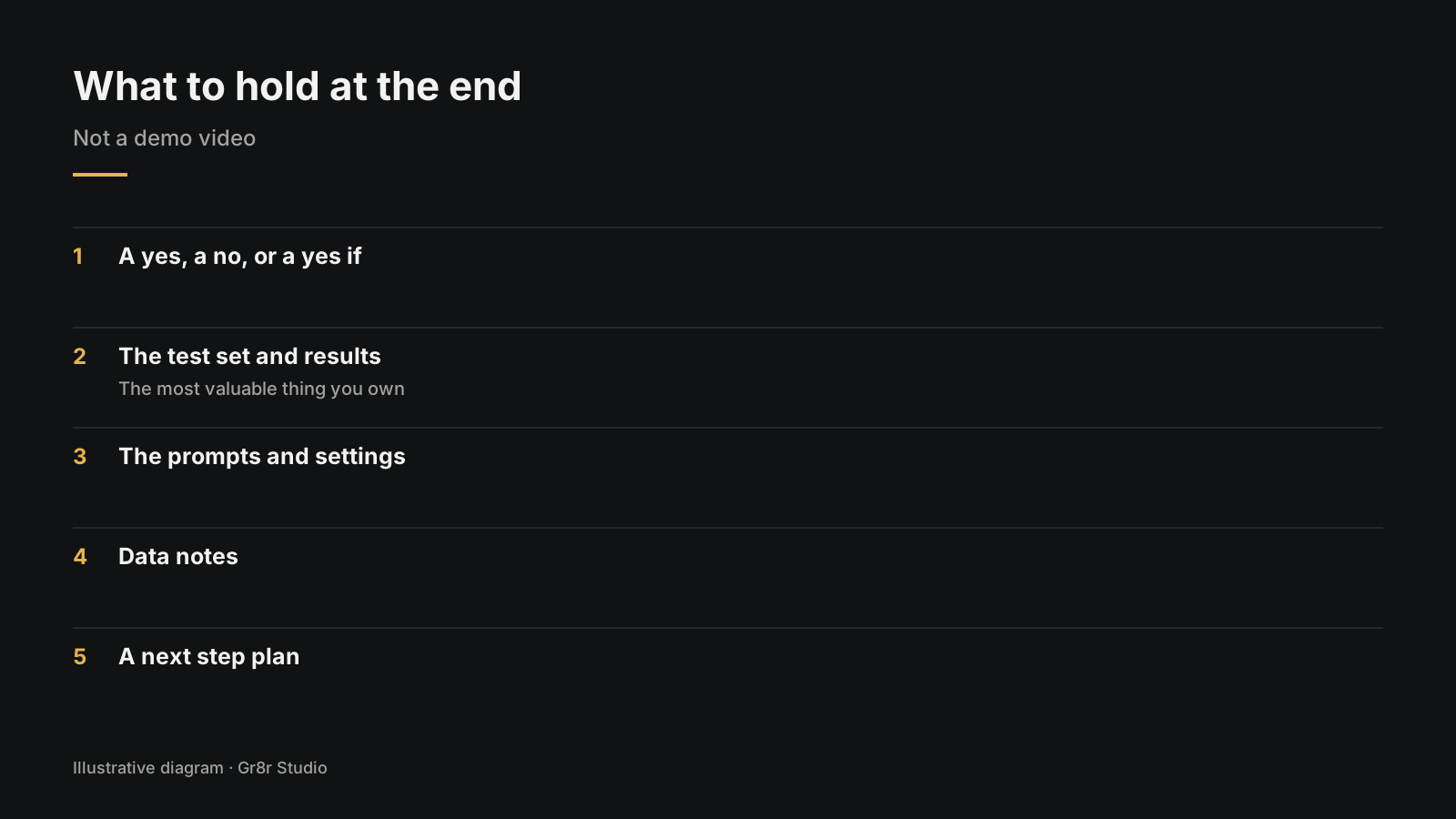
- A yes, a no, or a "yes, if". In one paragraph, against the bar you set.
- The test set and results. The real inputs, what the model produced, and how each was scored. This is the most valuable thing you will own.
- The prompts and settings that produced the best result, and the ones that failed.
- Data notes. What was missing, messy or sensitive. Often the biggest finding is about the data, not the model.
- A next step plan. What a real build would need: integrations, review steps, cost per run, risks.
If the team that built it hands you only a link to a demo, ask for the other four.
When should you throw it away?
Throw the code away in most cases. Keep everything else.
A proof of concept is written fast on purpose. It usually skips what a product needs: tests, error handling, access control, logging, monitoring and a plan for when the model is wrong. Carrying that code forward means carrying the shortcuts too.
Throw the whole idea away when:
- The result missed the bar and the misses were not close
- The data you need does not exist, or you are not allowed to use it
- The cost per run makes the job more expensive than doing it by hand
- A person still has to check every output fully, so nothing is saved
A "no" is a good result. It cost a few days instead of a few months.
When is it worth keeping?
Keep building when the answer is yes, or "yes, if" and the "if" is something you can fix.
What carries forward:
- The test set. It becomes the check you run every time the prompt or model changes.
- The bar. It becomes the quality target for the product.
- The data notes. They become the first tasks in the real build.
- Small, clean parts of the code, if an engineer reviews them and they fit the product's structure. This is the exception, not the rule.
Then move to design. An AI feature still needs screens that show users what the model did and what to do when it is wrong. See AI product design guide and AI feature error states.
Why do so many stop after the proof of concept?
Gartner put a number on it. In a 29 July 2024 press release it predicted that "at least 30% of generative AI (GenAI) projects will be abandoned after proof of concept by the end of 2025, due to poor data quality, inadequate risk controls, escalating costs or unclear business value" (Gartner, press release, 29 July 2024, via Internet Archive copy, fetched 25 Oct 2026).
Look at the four reasons. Three of them, data, risk and cost, can be tested inside a good proof of concept. The fourth, unclear value, is fixed by writing the question and the bar before you start. A proof of concept that ends in "it kind of works" has often skipped that page.
How does Gr8r run one?
Our way of working is a first concept within 48 hours of kickoff and a revised draft by day 2 to 3. That pace is for the first thing you can react to, so the question and the bar get tested against something real early. It is not a promise about when the full proof of concept ends; that depends on the question.
Clients own everything once it's paid for. To start, see product discovery.
Frequently asked questions
What is an AI proof of concept?
A small, short build that tests one question: can AI do one specific job well enough, on your real data, to be worth building properly? It is an experiment, not a product.
What is the difference between a proof of concept and a prototype?
A proof of concept tests whether something can work at all. A prototype tests how it should look and feel for users. An AI feature often needs the proof of concept first, because the model may not be good enough.
Should you keep the code from an AI proof of concept?
Usually not. It was written fast to answer a question, without the testing, security and monitoring a product needs. Keep the prompts, test set, results and lessons, and rebuild the code properly.
Why do AI proofs of concept fail?
Gartner predicted in a 29 July 2024 press release that at least 30 percent of generative AI projects would be abandoned after proof of concept by the end of 2025, citing poor data quality, inadequate risk controls, escalating costs or unclear business value.
How fast does Gr8r show a first concept?
Our way of working is a first concept within 48 hours of kickoff and a revised draft by day 2 to 3.
About the author
Tanjim Islam is the founder and CEO of Gr8r Studio. He founded the studio in 2023. Here he writes about how Gr8r approaches hiring, product design and AI engineering. More on the About page.
If you want help with this, book a 30 minute call.
Related reading
- Glaze, built by Gr8r for its own portfolio
- product discovery
- what product discovery is
- what drives the cost of an AI app
- talk to us