

Your Vibe Coded MVP Broke: Rescue or Rebuild?

Tanjim Islam
Founder & CEO · · 7 min read


To fix a vibe coded app, audit it before you touch it. Score twelve signals across code, data and user experience. If a few specific parts fail, rescue them. If the structure is sound but messy, refactor. If the data model or security is wrong at the root, rebuild the core and keep what works.
Why do vibe coded apps break?
They break because the tool built exactly what was asked, and nobody asked for the hard parts. A prompt like "build me a CRM for dentists" gets you screens that work on the happy path. It rarely gets you access rules, error handling, empty states or a data model that will survive your tenth customer.
That is fine for a demo. It becomes a problem the week real users arrive. Someone pastes an odd value. Two customers see each other's data. A page that loaded instantly with five rows takes forever with five thousand. The founder asks the AI tool to fix it, the fix breaks something else, and the loop begins.
The question is whether to patch, refactor or start again. Guessing is expensive in both directions. Rebuild too early and you throw away weeks of real work. Patch too long and you pour money into a foundation that cannot hold.
What are the 12 signals that decide rescue or rebuild?
Score each signal green, amber or red. The pattern tells you more than any single score.
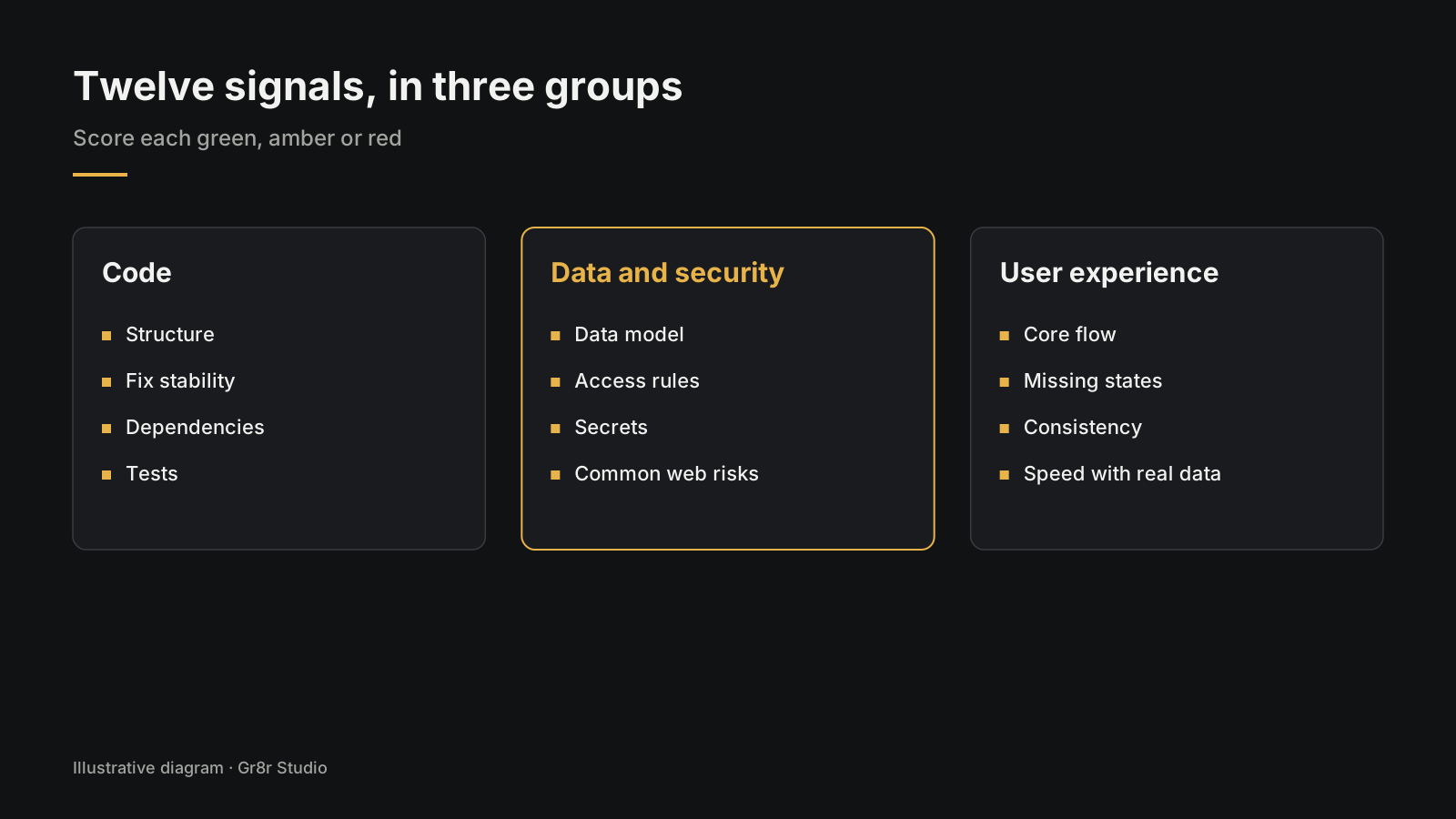
Code signals
- Structure. Can someone new find where a feature lives? Red if logic is copied across many files.
- Fix stability. Does fixing one bug create another? Red if every change breaks something.
- Dependencies. Are the libraries current and actually used? Red if there are many unused or outdated packages.
- Tests. Is there any automated check on the core flow? Red if none, and nobody can say what "working" means.
Data and security signals
- Data model. Do the tables match how your business works? Red if core concepts are missing or jammed into one table.
- Access rules. Can one customer reach another's data? Supabase's documentation warns that "A table in an exposed schema without RLS is readable and writable by any role with a grant on it" (Supabase, Row Level Security, fetched 25 Oct 2026). Red if row level rules are missing on customer tables.
- Secrets. Are API keys kept out of the browser code? Red if any secret key ships to the client.
- Common web risks. Check the app against the OWASP Top 10, the standard list of web application security risks (OWASP Top 10). Red on any broken access control.
User experience signals
- Core flow. Can a new user finish the main job alone? Red if they get stuck.
- Missing states. Are empty, loading and error screens designed? Red if most are blank or broken.
- Consistency. Do buttons, forms and wording behave the same way across screens? Red if every page feels like a different app.
- Speed with real data. Does it stay usable with realistic volumes? Red if it slows to a crawl.
Some builder tools now include their own checks. Lovable, for example, documents built in security scans, API key protection and database access checks (Lovable docs, Security overview). Run them, and treat them as a starting point for your own audit.
How do you decide: rescue, refactor or rebuild?
Use the pattern of reds.
| Pattern | Decision | What it means |
|---|---|---|
| Reds only in UX signals | Rescue | Keep the code, redesign and rebuild the screens that fail |
| Reds in a few code signals, data and security green | Refactor | Keep the data model, clean up structure, add tests, fix screens |
| Red on data model or access rules across the app | Rebuild the core | Design the data model and access rules properly, then move over the screens and logic that work |
| Reds everywhere | Rebuild | Use the old app as a living spec, and start fresh |
Two rules sit on top of the table. Any red on access rules or secrets is fixed first, whatever else you decide, because it puts customers at risk today. And a rebuild should still reuse what you learned: the old app is the best spec you have.
What does an audit look like in practice?
Here is a worked example, written as an illustration. Picture a scheduling app built in a weekend with an AI builder, now used by three paying clinics.
- Code: structure amber, fix stability red, dependencies green, tests red.
- Data and security: data model green, access rules red on one table, secrets green, OWASP check amber.
- UX: core flow green, missing states red, consistency amber, speed green.
In this illustration, the data model holds. The one red access rule is fixed first. Then the team adds tests around booking, designs the missing states, and cleans up the files where fixes kept breaking. That makes it a refactor.
Change one fact in the example, so the data model has no idea of separate clinics at all, and the answer becomes a core rebuild.
What should you do before you start fixing?
Freeze new features for the length of the audit. Every new prompt into the builder adds to the pile you are trying to judge.
Then gather four things: access to the repository and database, a list of the bugs users have reported, the three flows that matter most, and anyone who knows why things were built the way they were. Put the repository in an account you own, if it is not already.
If the app has an AI feature inside it, check how it behaves when the AI is wrong or slow, and whether a person approves anything risky. The path from prototype to a production AI feature.
When is it worth redesigning the product at the same time?
Redesign when the UX signals are mostly red and you are touching the screens anyway. Leave it when users are happy with the flow and the problems are underneath.
Changing design and engineering at once is more work to coordinate, and it can save you doing the screens twice. How to redesign without losing your existing users is in how to redesign a SaaS product. To write the user experience findings down in a form a team can act on, use the UX audit report template.
Where does this fit in building v1?
A rescue is often the moment a prototype becomes a real product. The wider playbook for that step is in how to build a SaaS MVP after you raise. What a rebuild costs and how long it takes depends on the same drivers as any v1, covered in how long an MVP takes.
Frequently asked questions
Can a Lovable or Bolt app go to production?
Sometimes, yes. Tools like Lovable and Bolt can produce a solid start. Before real customers use it, check data access rules, secrets, error handling and the screens around the happy path. If those hold up, you can harden it; if not, you rebuild the weak parts.
When should you rebuild a vibe coded app instead of fixing it?
Rebuild when the data model is wrong for your business, when security problems run through the whole app, or when every fix breaks something else. Fix or refactor when the structure is sound and the problems sit in specific screens or features.
How long does it take to rescue a vibe coded app?
It depends on what the audit finds. Start with a short audit that scores the app on code, data and user experience, then plan the work from what it finds. Anyone quoting a timeline before looking at the code is guessing.
Should you redesign a vibe coded app during the rescue?
Redesign when the user experience signals are mostly red and you are touching the screens anyway. Leave the design alone when users are happy with the flow and the problems sit underneath, in the code or the data.
Who owns the code after a rescue?
You should. Keep the repository in your own account, and make sure the contract says you own the code and designs once they are paid for. At Gr8r, clients own everything once it's paid for.
Next step
For a worked example of a written review, read our UX audit of Cendara, a claims product we built. One of its twelve findings was high: table pages scroll sideways on tablets and phones. Built by Gr8r for its own portfolio. Not client work.
If you want help with this, book a 30 minute call.
Related reading
- how to build a SaaS MVP after you raise
- how long an MVP takes
- the UX audit report template
- the AI ownership checklist
- MVP Development
Tanjim Islam is the founder of Gr8r Studio, a digital product and AI engineering partner for scaleups and enterprise teams, founded in 2023.