

Redesign, Refactor or Rebuild Your SaaS Product?

Tanjim Islam
Founder & CEO · · 7 min read


The three words get mixed up in meetings. Someone says "we need a redesign" and means the code. Someone else says "rebuild" and means new screens. This post gives each word one meaning, then a simple test to pick between them.
What do redesign, refactor and rebuild actually mean?
Think of a restaurant.
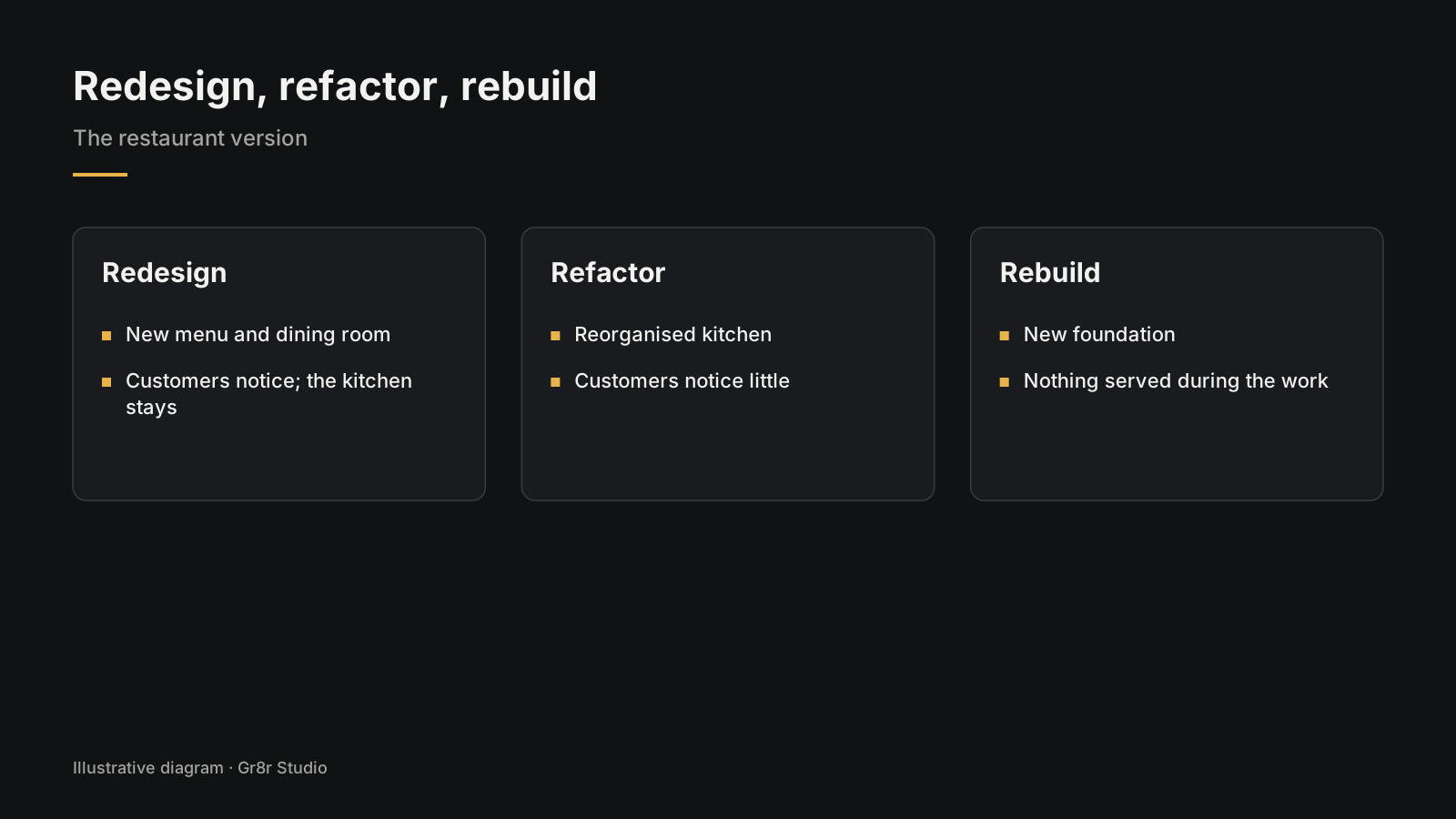
- Redesign is changing the menu and the dining room. Customers notice. The kitchen stays.
- Refactor is reorganizing the kitchen. Customers notice nothing, except that food arrives faster and fewer orders go wrong.
- Rebuild is knocking the building down and pouring a new foundation. Nothing is served while the work goes on, unless you build next door first.
In software terms: a redesign changes screens, flows and words. A refactor changes the structure of the code without changing what it does. A rebuild replaces the code, and often the design too.
The words are separate because the problems are separate. A product can look tired and run on clean code. Another can look fine and be held together with tape.
Which symptoms point to which option?
Start with what you can see this week. Each row below is something a founder can check without a consultant. These are rules of thumb, not a diagnosis.
| Symptom you can see | Points to |
|---|---|
| Users stall on the same two or three screens | Redesign |
| Support answers the same "how do I" questions | Redesign |
| New features have no obvious place in the navigation | Redesign |
| Demos need someone talking over the screen | Redesign |
| Small changes take engineers days, not hours | Refactor |
| Fixing one bug creates another somewhere else | Refactor |
| Only one engineer understands a core part | Refactor |
| Releases are rare because they are scary | Refactor |
| Both lists apply, and the stack is no longer supported | Rebuild, gradually |
| The product must do something the current structure cannot hold | Rebuild, gradually |
When is a redesign the right call?
When the pain is on the user's side of the glass.
Here is an illustration, not a real client. A scheduling tool started with one screen: a calendar. Three years later it has reports, team settings, billing and an integrations page, all added as new tabs. New customers open it and see nine tabs with no clear start. Support spends Monday answering "where do I add a teammate?" The code is fine. The map is not.
That product needs a redesign. New navigation, clear names, an onboarding path, maybe fewer screens. Engineers change the front end, but the data and logic underneath stay.
Before a redesign, find out what users rely on today. Moving a button they use daily can cost more goodwill than the new design earns. We cover that.
When is a refactor the right call?
When users are mostly fine and the team is not.
The signs live in the engineering channel. A "quick change" turns into a week. A fix to invoices breaks the export. Everyone avoids one folder. Releases slip from weekly to monthly because each one needs a weekend of checking.
A refactor cleans that up in steps. Tests go around the risky parts first. Then the tangled code is pulled apart, one area at a time, while the product keeps shipping. Users should not see a thing, except that bugs drop and features arrive sooner.
If your product was put together fast with AI coding tools and now fights every change, our post on how to fix a vibe coded app goes deeper on that case.
When is a rebuild worth the risk?
Rarely, and almost never all at once.
The warning is old and still true. In 2000, Joel Spolsky wrote that Netscape made "the single worst strategic mistake that any software company can make" when it decided "to rewrite the code from scratch" (Joel on Software, Things You Should Never Do, Part I, 6 April 2000, fetched 25 Oct 2026). His point: old code looks messy because it holds years of fixes for real problems. A rewrite throws them away.
There is a safer way. Martin Fowler describes the "Strangler Fig," named after a vine that slowly grows around a host tree until it stands on its own. He writes that the term "is now often used to describe a gradual approach to legacy modernization" (Martin Fowler, Strangler Fig, 22 August 2024, fetched 25 Oct 2026).
In practice: build the new billing module next to the old one. Move a few customers. Watch. Move the rest. Switch the old one off. Repeat with the next part. The product keeps running the whole time.
A rebuild is worth it when the stack is no longer supported, when the product must do something the structure cannot hold, or when refactoring would touch nearly every file anyway. Even then, go piece by piece.
How do you score your own product?
Two scores, five questions each. Answer yes or no. Be honest; nobody is grading you.
User pain score
- Do new users need help to finish their first task?
- Do support tickets repeat the same few questions?
- Do sales demos need someone to explain the screens?
- Has a key number (activation, upgrades) dropped with no clear cause?
- Do you hesitate to show the product to investors?
Code pain score
- Do small changes regularly take days?
- Do fixes often break something else?
- Is there a part of the code only one person can touch?
- Have releases slowed down in the last six months?
- Is part of the stack no longer supported?
Read the result:
- User pain 3 or more, code pain 2 or less: redesign.
- Code pain 3 or more, user pain 2 or less: refactor.
- Both 3 or more: plan a gradual rebuild, starting with the part that hurts most.
- Both 2 or less: you may need neither. Fix the top few problems and keep shipping.
This is a rule of thumb, not a diagnosis. It tells you which question to ask next.
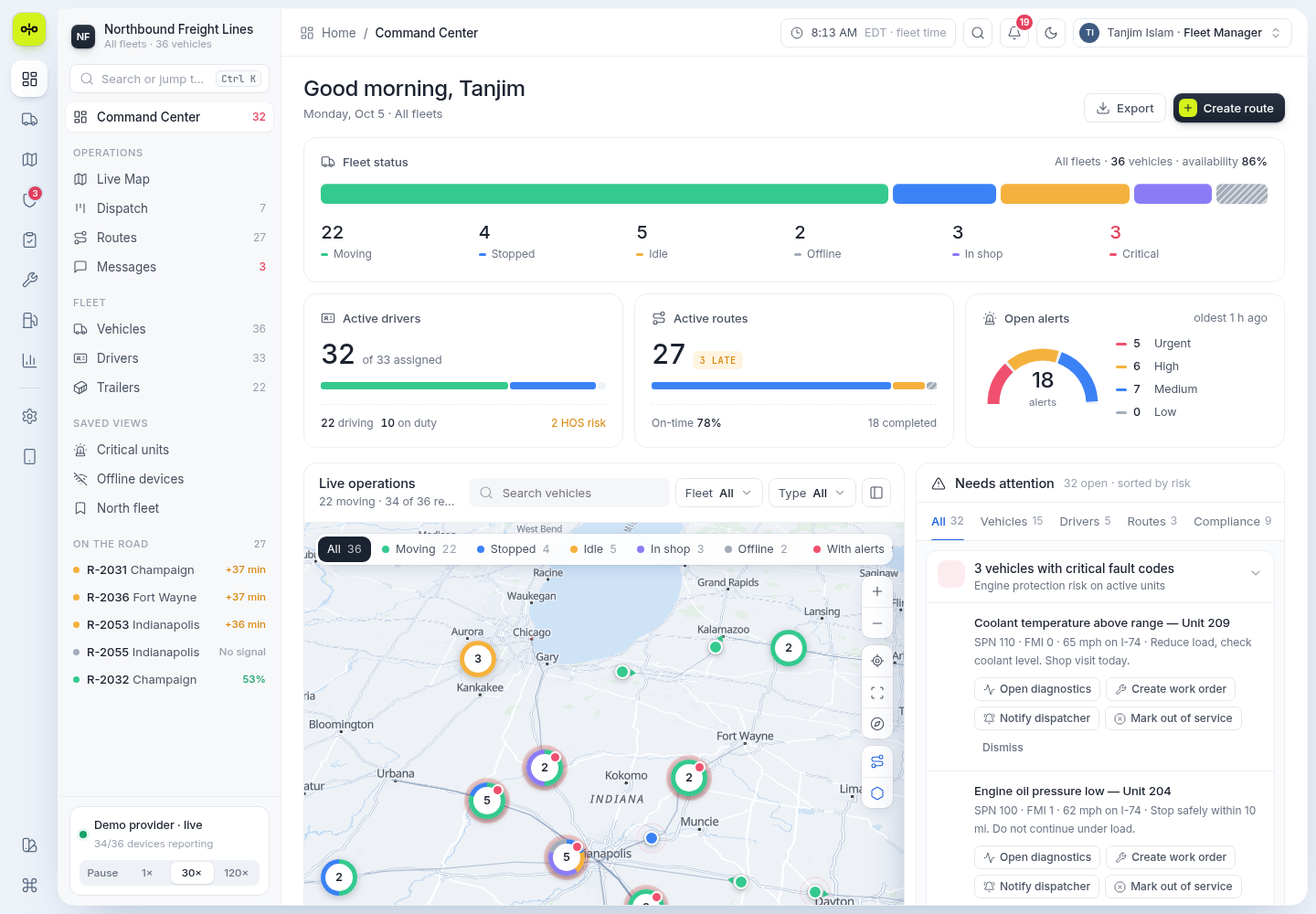
A dense screen is a good place to practise. Axle, a fleet command center Gr8r built, puts Live Map, Dispatch, Routes, Vehicles, Drivers and Trailers in one sidebar beside a fleet status panel. Ask the five user pain questions of a screen like that before you decide what to change. Built by Gr8r for its own portfolio. Not client work.
What should you do first?
Get an outside look before you commit money to any of the three.
Your team is too close. Designers think the problem is design. Engineers think it is code. An audit looks at both and ranks what actually hurts users. Our guide to doing a UX audit screen by screen shows how to start on your own, and Gr8r offers a free UX audit to the first 5 companies that ask if you want someone else to walk it.
Then decide the scope. If it is a redesign, our product design work starts from the audit findings, with a first concept within 48 hours of kickoff and a revised draft by day 2 to 3. If the code needs work too, see AI software development. Whatever is built, clients own everything once it's paid for.
Frequently asked questions
What are the signs your SaaS product needs a redesign?
Users get stuck on the same screens, support answers the same how do I questions, new features have no obvious place to live, and sales demos need a guide to explain the interface. The code itself can still be healthy.
What is the difference between a redesign and a rebuild?
A redesign changes what users see and do: screens, flows and labels. A rebuild replaces the code underneath. You can redesign without rebuilding, and you can rebuild without changing the design at all.
Why is rebuilding from scratch risky?
The old code holds years of fixes for edge cases nobody wrote down. A rewrite throws those away, and while it runs, the live product barely improves. Joel Spolsky called rewriting from scratch the single worst strategic mistake a software company can make.
What is the strangler fig approach?
It is a way to replace an old system gradually. You build new parts around the old one and move users over piece by piece, until the old system can be switched off. Martin Fowler named and described the pattern.
How do I decide which option my product needs?
Get an outside review of both the experience and the code. Score the user pain and the engineering pain separately. High user pain points to redesign, high code pain to refactor, and both together to a careful, gradual rebuild.
About the author
Tanjim Islam is the founder and CEO of Gr8r Studio. He founded the studio in 2023. Here he writes about how Gr8r approaches hiring, product design and AI engineering. More on the About page.
Before a redesign, an audit tells you what to fix. Our UX audit of Veluno, a product we built, found 13 issues, and the three high ones were counts that disagree, rows a keyboard can't reach and a phone layout that scrolls sideways. Built by Gr8r for its own portfolio. Not client work.
If you want help with this, book a 30 minute call.
Related reading
- Axle, built by Gr8r for its own portfolio
- free UX audit for the first 5 companies
- how to do a UX audit
- how to fix a vibe coded app
- SaaS MVP product design guide
- talk to us