

Can You Build Your Own AI Agent? When to Do It Yourself and When to Hire

Tanjim Islam
Founder & CEO · · 5 min read


Can you develop your own AI agent? Here is the honest answer, from a team that builds agents for a living. For the wider picture of agents at work, see how to build AI agents for business workflows.
Can you really build your own AI agent?
Yes. The tools have got good enough that a curious operator can build a useful agent in a day or two.
An agent, at its simplest, is a model that uses tools in a loop. Anthropic's engineering team describes agents as "typically just LLMs using tools based on environmental feedback in a loop" (Anthropic, Building effective agents, 19 Dec 2024, fetched 25 Oct 2026). OpenAI's guide breaks one down into three parts: a model, tools, and instructions (OpenAI, A practical guide to building agents, fetched 25 Oct 2026).
That is not hard to set up. What is hard is making it right every time, on real data, with real consequences.
Do you even need an agent?
Check this first. Many jobs need less.
Anthropic's advice is to find "the simplest solution possible, and only increasing complexity when needed. This might mean not building agentic systems at all." A single well written prompt, or a fixed workflow where the steps never change, is cheaper and easier to trust.
OpenAI's guide points agents at work that has "previously resisted automation": decisions full of exceptions, rules that have become hard to maintain, and heavy use of unstructured text like emails and documents. If your job is a clean, repeatable checklist, a simple automation may do.
Sometimes a plain assistant is enough. Ask Ali, an assistant Gr8r built, opens on one line, "Hi, I'm Ali. Ask me anything.", and a single box to type in. The page shows no agents and no workflow screens. Built by Gr8r for its own portfolio. Not client work.
When does doing it yourself make sense?
When the job is narrow and a mistake is cheap.
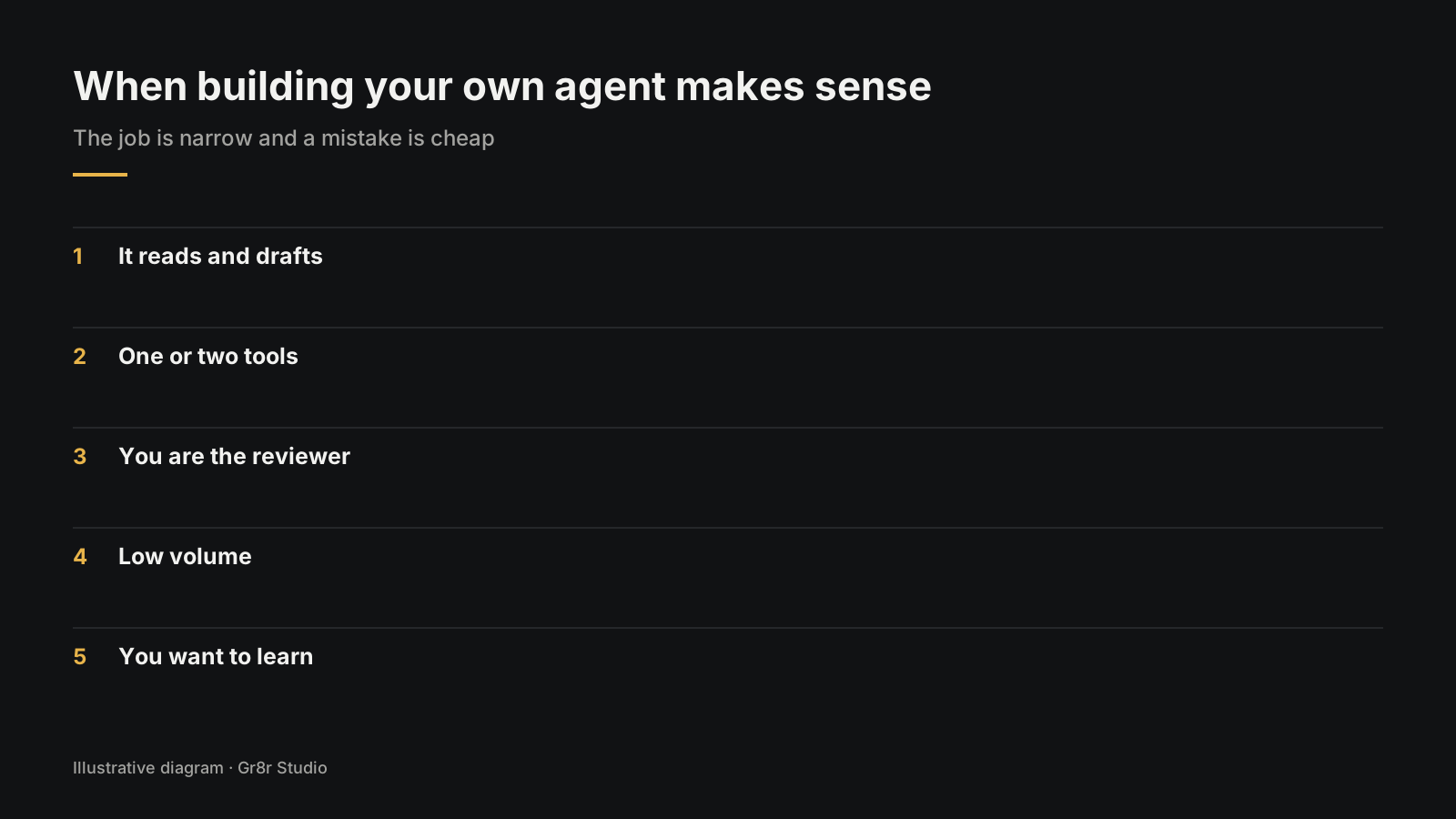
- It reads and drafts. Summarising tickets, sorting emails, pulling fields out of a PDF, drafting a reply for you to send.
- One or two tools. Your inbox and a spreadsheet, not five systems.
- You are the reviewer. You see every output before it goes anywhere.
- Low volume. A few dozen items a day, not thousands.
- You want to learn. Building one yourself teaches you what the job really involves.
Here is an illustration, not a real client story. An ops manager builds an agent that reads supplier emails each morning and writes a one line summary of each into a sheet. If it gets one wrong, she notices and fixes the row. That is a great do it yourself agent.
When should you hire?
When the agent starts doing things that cost money if they go wrong.
- It acts, not just drafts. It sends emails, edits records, issues refunds or places orders.
- It touches several systems. Each connection needs access, error handling and a plan for when that system is down.
- It handles money or personal data. You need permissions, logs and a security review.
- Other people depend on it. A team uses it every day, so it needs monitoring and someone on call.
- You need proof it works. A test set of real examples, rerun whenever a prompt or model changes.
OpenAI's guide says sensitive or irreversible actions, such as "canceling user orders, authorizing large refunds, or making payments", should trigger human oversight until confidence in the agent's reliability grows. Designing that oversight well is real work. We cover it in designing the review step before an AI agent acts.
What usually goes wrong with do it yourself agents?
Three things, again and again.
- No test set. It worked on the five examples you tried. It fails on the sixth kind you did not think of.
- Too much freedom too soon. The agent can send, delete or pay before anyone has checked how often it is right.
- Nobody owns it. The person who built it moves on, and nobody knows how it works or where the keys are.
None of these is about coding skill. They are about treating the agent like a product, with tests, limits and an owner.
What is a good middle path?
Start yourself, then hire for the hard parts.
Build the narrow version. Keep it in draft mode, with you approving every output. Save every prompt, every example where it got things wrong, and notes on what the job needs. If it proves useful and you want it to act, run daily or serve a team, that folder becomes the best brief a partner could ask for.
Whoever builds it, make sure you own the result: the prompts, the test set and the accounts. Our AI ownership checklist lists what to cover. At Gr8r, clients own everything once it's paid for.
How do you choose help when you need it?
Ask to see agents they have shipped that you can open, how they test, and who approves the agent's actions. The full process is in how to hire an AI engineering partner. If you want to talk through yours, see AI agent development or talk to us.
Frequently asked questions
Can I develop my own AI agent?
Yes. For a narrow job that reads and drafts, such as summarising tickets or sorting emails, no code tools and model APIs make it realistic. Keep a person approving anything the agent sends or changes.
Do I need to know how to code to build an AI agent?
Not for a simple one. No code builders can connect a model to a few tools. You will need code, or someone who writes it, once the agent touches several systems, needs testing at scale or must run reliably every day.
When should I hire someone to build an AI agent?
When it acts in several business systems, moves money or customer data, needs a test set and monitoring, or many people depend on it daily. Those are the parts where mistakes cost real money.
What is the hardest part of building an AI agent?
Usually not the model. It is the tools it uses, the testing against real examples, and the screens where people approve its work. Those take most of the time in a real build.
Can I start myself and hire later?
Yes, and it is often the best path. A working do it yourself version shows what the job needs. Keep your prompts, examples and notes, because they make a strong brief for a partner.
Next step
If you want help with this, book a 30 minute call.
About the author
Tanjim Islam is the founder and CEO of Gr8r Studio. He founded the studio in 2023. Here he writes about how Gr8r approaches hiring, product design and AI engineering. More on the About page.