

Cofounder, Hire, Freelance or Product Partner for Your v1?

Tanjim Islam
Founder & CEO · · 6 min read


Four options can build a startup's first product: a technical cofounder, your own first hire, a freelancer, or a product partner. Pick a cofounder for a long term owner, a hire when you can wait and have someone to lead them, a freelancer for one narrow piece, and a product partner for a defined v1 that needs design, engineering and AI at once.
This post answers step 1 of our guide to hiring an AI engineering partner: do you need a partner at all? We are a product and engineering partner ourselves, so read our view with that in mind.
Why is this choice hard for a first product?
Because the first product is when you know the least and need the most skills at once.
A v1 needs someone to decide what to build, someone to design the screens, someone to write the code, and, for an AI product, someone to test whether the AI is right often enough. Later, those can be four people. On day one, you may have budget for one.
Each option below solves that problem differently. None is right for everyone, including ours.
When does a technical cofounder make sense?
When you want a person who owns the product for years, and you are ready to share equity for it.
A cofounder makes product calls with you, carries the product through pivots, and stays when things are hard. That is worth a lot. The cost is time: finding the right person can take months, and a bad match is hard to undo.
Watch for this trap. Some founders hold back all product work until a cofounder appears. A clickable prototype or a scoped first version, built another way, often helps you find that cofounder, because you are showing something real.
When should you hire your own first engineer?
When the product is the core of the business for years, you can wait for hiring, and someone on your side can lead the work.
Your own team builds knowledge that stays. The catch is that a first engineer still needs direction. If nobody on the founding team can set priorities and review the work, a single hire can end up guessing.
For a fuller look at this trade, see our comparison of a partner and an in house team.
When is a freelancer the right call?
When the work is narrow and you can describe it well.
One integration. One landing page. A set of screens from a written list. A good freelancer can do that well and quickly.
The risk grows with the scope. A v1 that needs design, engineering and AI testing at once is a lot for one person, and if they move on, the knowledge goes with them. Keep the code and accounts in your name from day one either way. More on this in freelancer or product partner.
When does a product partner fit?
When you have a defined v1, a deadline in months, and you need several skills working together.
A product partner brings a designer, engineers and someone who has tested AI in production, all at once, without a recruiting cycle. The trade off is cost per month and the risk of depending on an outside team. Both are manageable if you plan the handover from the first week.
A product partner is the wrong choice when the work will run for years at the heart of the business and you are ready to hire. It is also wrong when the scope is a single small task a freelancer could finish.
How do the four options compare?
A technical cofounder suits long term ownership, a first hire suits years of core work, a freelancer suits one narrow piece, and a product partner suits a defined v1.
| Technical cofounder | First hire | Freelancer | Product partner | |
|---|---|---|---|---|
| Time to start | Months to find | Weeks to months to hire | Days to weeks | Days to weeks |
| Who leads product calls | Cofounder with you | You | You | Shared, with you deciding |
| Skills at once | One or two | One | One | Several |
| Best for | Long term ownership | Core work for years | One narrow piece | A defined v1 |
| Main risk | A bad match | No one to lead them | Knowledge leaves with them | Dependence on an outside team |
These are general patterns from how each option is set up, not measured figures.
How do you move from a product partner to your own team later?
Plan the exit on day one. A partner built v1 should be easy to take over.
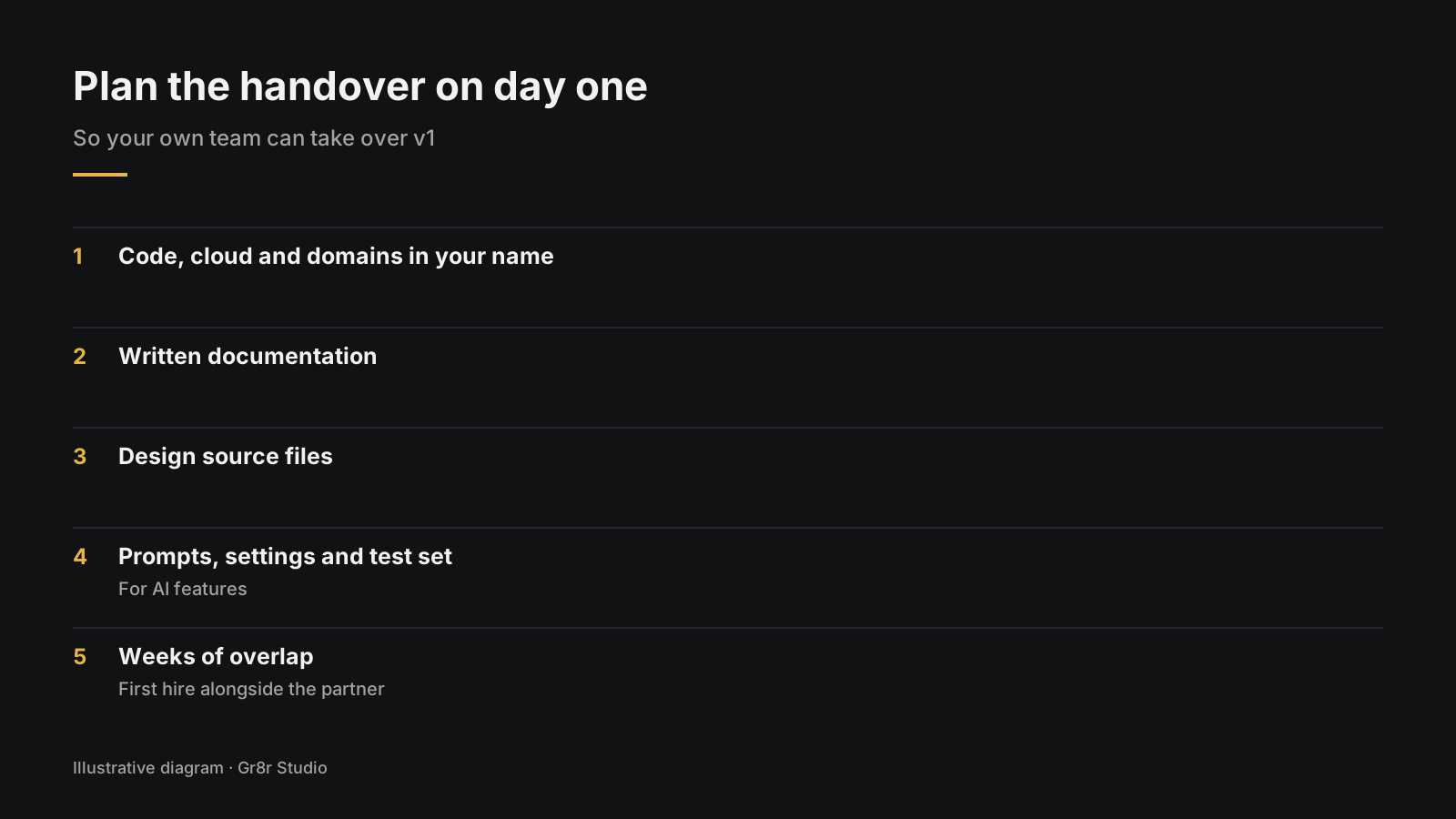
- Code, cloud accounts and domains in your name from the start.
- Written documentation of how the product is built and run.
- Design source files, not only exported images.
- For AI features: prompts, model settings and the test set of examples with right answers.
- A few weeks where your first hire works alongside the partner before the handover.
What the first weeks with any partner should look like is in your first two weeks with a new product partner. If you choose to build a SaaS v1, our SaaS MVP product design guide covers the screens.
What does Gr8r build for itself?
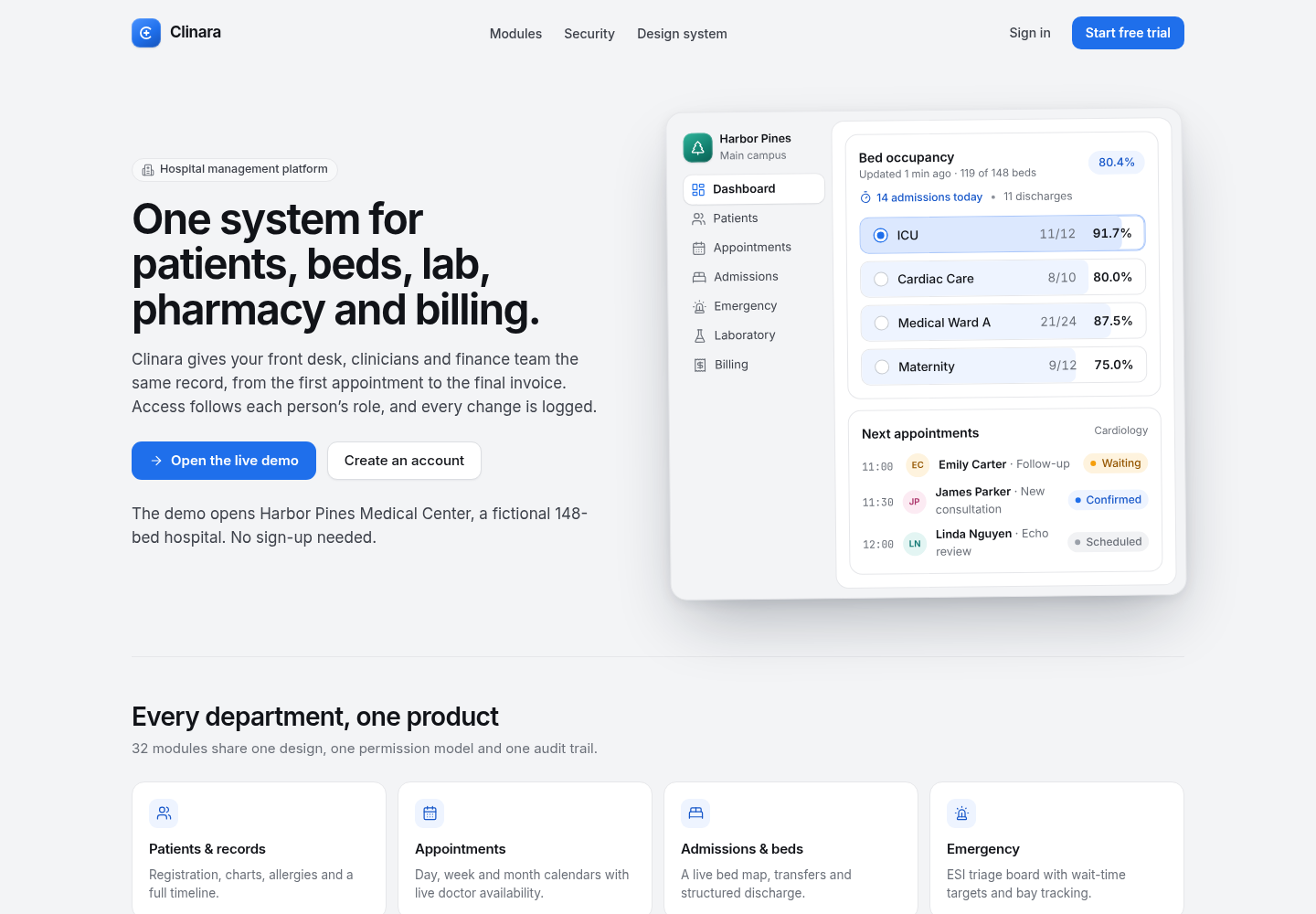
We build our own products as well as client work, so you can judge the craft before you call. Built by Gr8r for its own portfolio. Not client work. Two you can open without a login: Clinara, a hospital management SaaS, and Atrium, a hotel operating system for guests, rooms, stays and money. The full list is on our products page. Five first versions and what each left out are in MVP examples from our in house builds.
Frequently asked questions
Should a non technical founder find a technical cofounder?
If you want someone who will own the product for years and you are ready to share equity, yes. Finding the right person can take months, so many founders build a first version another way while they search.
Is a product partner cheaper than hiring?
It depends on the length of the work. A product partner costs more per month than one hire, but brings several skills at once and needs no recruiting time. For a short v1, that can cost less overall; for years of core work, your own team usually wins.
Can a freelancer build an AI product?
A freelancer can build a narrow piece well, such as one integration or one set of screens. A full AI product needs design, engineering and AI testing at once, which is a lot to ask of one person.
How do you move from a product partner to your own team?
Plan it from the start. Keep code and accounts in your name, ask for written documentation, and have your first hire work alongside the partner for a few weeks before the handover.
Who owns the work if a freelancer or product partner builds it?
You should, in writing. Any partner's contract should say code, designs, prompts, data and accounts belong to you once paid for. At Gr8r, clients own everything once it's paid for.
About the author
Tanjim Islam is the founder and CEO of Gr8r Studio. He founded the studio in 2023. Here he writes about how Gr8r approaches hiring, product design and AI engineering. More on the About page.
If you want help with this, book a 30 minute call.