

RPA vs AI Automation: Rules, Models or Both?

Tanjim Islam
Founder & CEO · · 7 min read


This post is about method, not tools. It shows how to sort each step of one process into rules, a model or both, so you stop arguing about RPA vs AI automation as if it were one big choice. If you want the basics first, read what AI automation is.
Is RPA or AI automation better for your process?
Neither, as a whole. The better question is which steps need judgment and which steps need obedience.
RPA is a bot that copies what a person does on screen. It logs in, opens a form, copies a number, pastes it somewhere else. IBM describes it as "rule-based software" that performs "business process activities at a high-volume" (IBM, What is robotic process automation?, page date not shown, fetched 25 Oct 2026).
An AI model does a different job. It reads. IBM draws the line in one sentence: "RPA is process-driven, whereas AI is data-driven." RPA bots "can follow only the processes defined by an end user," while AI can "recognize patterns in data, in particular unstructured data."
So picture a single invoice moving through your finance team. Opening the inbox, saving the PDF and typing totals into the accounting tool are obedience steps. Working out which supplier sent a blurry photo of a handwritten bill is a judgment step. One process. Two kinds of work.
What is the real difference between rules and models?
Rules give you the same answer every time. Models give you a good guess with a level of confidence.
| Rules (RPA, scripts, if this then that) | Models (AI that reads and classifies) | |
|---|---|---|
| Input it likes | Fixed screens, fields, columns | Emails, PDFs, photos, chat |
| Answer | Same every time | A best guess, sometimes wrong |
| How it breaks | A button moves, a field is renamed | A strange input gets a confident wrong answer |
| How you check it | Read the rule | Test it on many real examples |
| Who can change it | Anyone who can read the rule | Someone who can test and measure it |
Google's People + AI Guidebook gives a warning worth pinning to the wall: "Often a rule or heuristic-based solution will work just as well, if not better, than an AI version." It adds that a simpler solution is "easier to build, explain, debug, and maintain" (Google PAIR, User Needs + Defining Success, fetched 25 Oct 2026).
Start with rules. Add a model only where rules keep failing.
How do you decide, step by step?
Write the process down as a list of verbs. Open. Read. Check. Type. Approve. Send. Then run each verb through four questions.
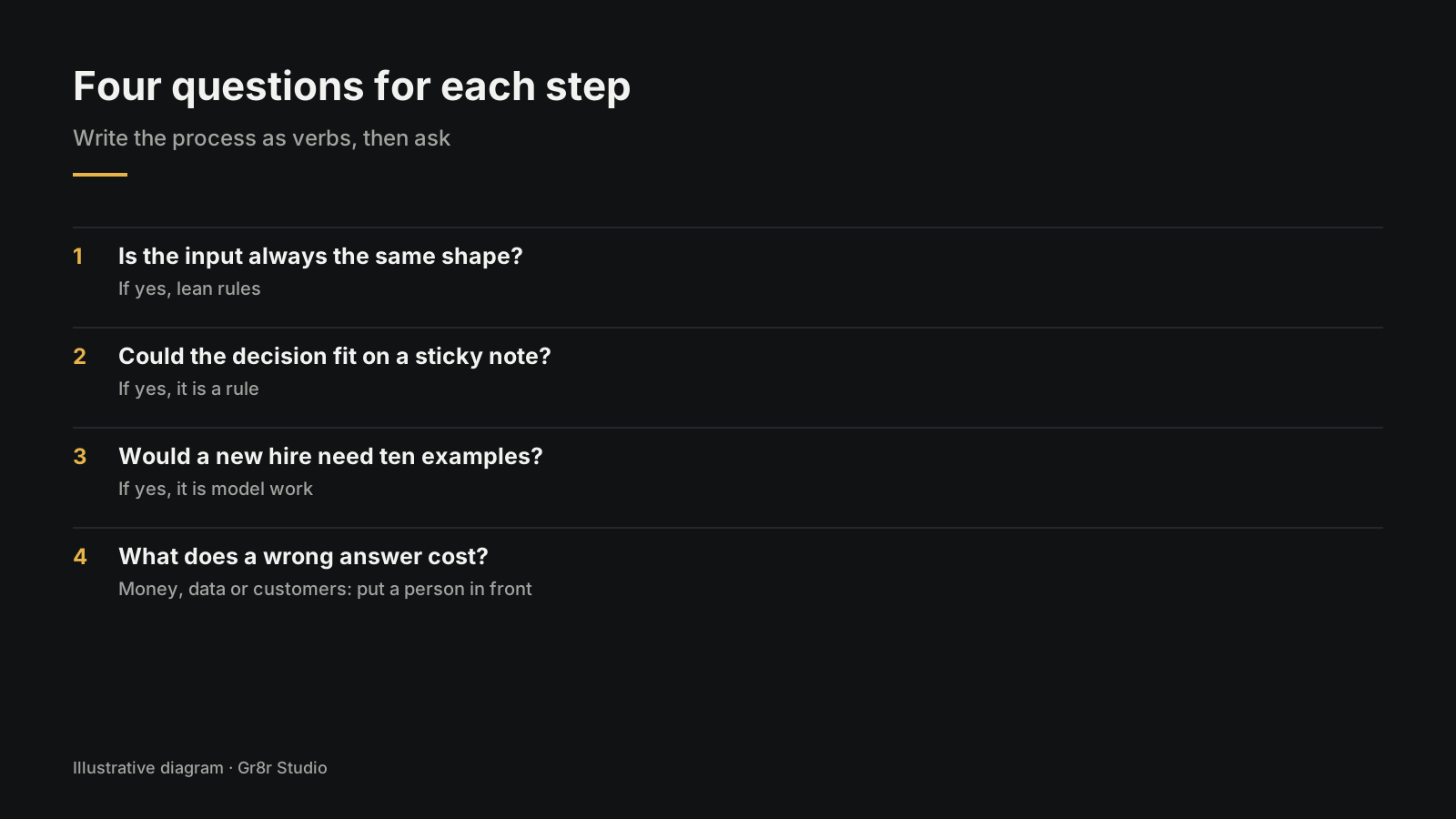
- Is the input always the same shape? A form with fixed fields, a report with fixed columns. If yes, lean rules.
- Could you write the decision on a sticky note? "If the total is over 5,000, ask the manager." If yes, it is a rule.
- Would you need ten examples to teach a new hire? "This email is a complaint, this one is a refund request." If yes, it is model work.
- What does a wrong answer cost? If it moves money, deletes data or reaches a customer, put a person in front of it, whatever runs the step.
What does a hybrid process look like on a real task?
Here is an illustration, not a real client. A property management firm gets maintenance requests by email, by web form and by text message. Today one coordinator reads every request, works out what is broken, picks a contractor and books the job in the work order system.
Sorted step by step, it looks like this:
| Step | Runs on | Why |
|---|---|---|
| Collect requests from three channels | Rules | Same sources, same places |
| Read the message and say what is broken | Model | Tenants write "the thing under the sink is dripping again" |
| Pull out unit number and urgency | Model, rules check | Model reads, a rule checks the unit exists |
| Pick the contractor for the trade | Rules | A fixed list by trade and building |
| Create the work order in the old system | Rules (RPA if there is no API) | Same screen every time |
| Flag gas, flood or no heat | Rules on the model's label | Never left to a guess alone |
| Tell the tenant the booking | Person approves the first weeks | It reaches a customer |
Count the rows. Most steps are rules. The model sits in two places, reading the words a person wrote. In our experience that is common.
Field service is a sector Gr8r builds in for itself. Kavero is a field service operations platform. Built by Gr8r for its own portfolio. Not client work. It sits behind a login, so there is no link here.
Where does RPA still win?
RPA earns its keep in three places.
- Old systems with no API. IBM notes that bots work "on the presentation layer of existing applications," so you can use them "where you don't have an application programming interface (API)." If your only way into a system is its login screen, a bot is often the honest answer.
- Steps that must never vary. Copying an approved total from one system to another should be boring. Boring is the goal.
- Audit trails. A rule leaves a clear record. IBM points out that RPA "can also provide an audit trail."
RPA has a known weak spot. IBM, citing a Forrester report, says "52% of customers claim they struggle with scaling their RPA program." Screen bots break when screens change. If the vendor of your old system ships a redesign, every bot that clicks through it needs fixing.
Where does an AI model earn its place?
Wherever a person reads before they act. Free text emails. Scanned documents. Photos of receipts. Support chats. Any step where the input looks different every time.
Keep its job small. A model should label, extract or draft. Rules should then decide what happens to that output. Anthropic, writing about agent systems built with "dozens of teams," says workflows "offer predictability and consistency for well-defined tasks" and recommends "finding the simplest solution possible, and only increasing complexity when needed" (Anthropic, Building effective agents, 19 Dec 2024, fetched 25 Oct 2026).
For how these pieces chain into a full flow with review queues, see our AI Automation guide. If you are weighing whether steps should be run by an agent instead, see AI agent, chatbot or workflow.
Can AI replace RPA completely?
Not in most offices. A model can read, but something still has to click, type and file. Sometimes that is an API call. Sometimes, with an old system, it is a bot on screen. IBM puts it simply: "RPA and AI also complement each other well."
What changes is where the bot gets its instructions. Before, a person read the email and told the bot what to type. Now a model reads the email and a rule tells the bot what to type. The bot stays. The reading moves.
Which checklist should you run before you build?
Print this and fill it in for one process.
- Every step written as a verb, in order.
- Each step marked Rules, Model, or Model then Rules.
- Every Model step has 30 or more real examples saved for testing. (Your own number; pick one you can actually collect.)
- Every step that moves money, deletes data or reaches a customer has a named person who approves it.
- Each system marked API or screen only. Screen only steps get RPA or a person.
- A low confidence path: where does a model's unsure answer go?
- One owner who gets the alert when a bot or a model fails.
If you are deciding whether to buy a ready tool for this or build your own flow, read custom AI or off the shelf tools.
How do you start?
Pick one process that hurts. Sort its steps with the four questions. Build the rules first, because they are cheap to test. Then add the model where people still read and type by hand. If you want help sorting a process, Gr8r builds this kind of flow under AI automation services.
Frequently asked questions
Is RPA dead now that AI is here?
No. RPA still does the clicking and typing in systems that have no API, and fixed rules still make the final decisions in most processes. AI models mostly take over the reading step that a person used to do before the bot ran.
Can AI replace RPA?
Rarely in full. A model can read an email or a PDF, but something still has to enter the result into your systems. That is an API call or, for old systems, a screen bot. The two usually work together.
Is RPA a form of AI?
No. RPA follows rules that a person defines and does the same thing every time. AI models learn patterns from data and make a best guess. IBM sums it up as RPA being process driven and AI being data driven.
Which is cheaper to run, RPA or AI automation?
It depends on the step. Rules are cheap to run and easy to check. Model steps cost money per call and need testing on real examples. That is why the safest design keeps the model small and lets rules do the rest.
When should a person stay in the loop?
Whenever a step moves money, deletes data or reaches a customer, and whenever a model is unsure. Send those cases to a review queue with the input and the proposed answer side by side, and let a named person approve.
About the author
Tanjim Islam is the founder and CEO of Gr8r Studio. He founded the studio in 2023. Here he writes about how Gr8r approaches hiring, product design and AI engineering. More on the About page.
If you want help with this, book a 30 minute call.
Related reading
- Products Gr8r built itself, including Kavero
- what AI automation is
- AI Automation guide
- AI agent, chatbot or workflow
- custom AI or off the shelf tools
- AI automation services
- talk to us