

Signs Your Startup Has Outgrown Its No Code Site

Tanjim Islam
Founder & CEO · · 8 min read


This post is for founders wondering if their Framer or Webflow site needs custom code. It lists the real signs, the false alarms, and what a move involves. It does not pick a platform for you. Tool comparisons live on our compare pages.
What are the signs a startup has outgrown its no code site?
Seven signs. One alone is rarely enough. Three or more means plan a move.
- You keep hitting plan limits.
- Pages need live data from your product.
- The site and the app need to share sign in.
- Your security team wants control of hosting or source code.
- The site fails speed checks on real phones, even after you fix the images.
- Every change needs a developer anyway.
- Workarounds pile up: scripts, embeds and glue tools nobody remembers adding.
Below is how to check each one yourself, with your site settings and a phone.
How do you know you are hitting plan limits?
Open your plan page and count. No code builders sell limits by plan, and a growing startup walks into them.
Framer's pricing page lists 10 CMS collections on its Pro plan. Framer's Pro plan includes 2,500 CMS items, then $20 per 10,000 items up to 40,000 (Framer, Pricing, fetched 25 Oct 2026). Collection add ons raise that to 40 collections, and Enterprise has custom limits (Framer, Pricing, page date not shown, fetched 25 Oct 2026). Webflow says "the number of Collection items you can import depends on your site plan type" (Webflow Help, How do I import content into the Webflow CMS?, updated 18 Aug 2026, fetched 25 Oct 2026).
Picture your team adding a page for every integration. Two hundred pages become two thousand. If each batch means a bigger plan, or a cap you cannot buy past, the platform is shaping your roadmap.
How to check: compare your item count today, and in 12 months, with your plan's limits.
When does a site need to act like the product?
When a page has to show something only your app knows.
Pricing pulled from your billing system. A calculator that runs your real formula. A no code CMS holds content you type in. It is not built to read your database each time a page loads.
Sign in is the same. If a visitor logs in on the site and lands in the app signed in, the two share accounts and code. That is a custom build.
Our website platform guide lists these reasons in short. The test: if a feature needs your product's data or user accounts, the site now behaves like the product.
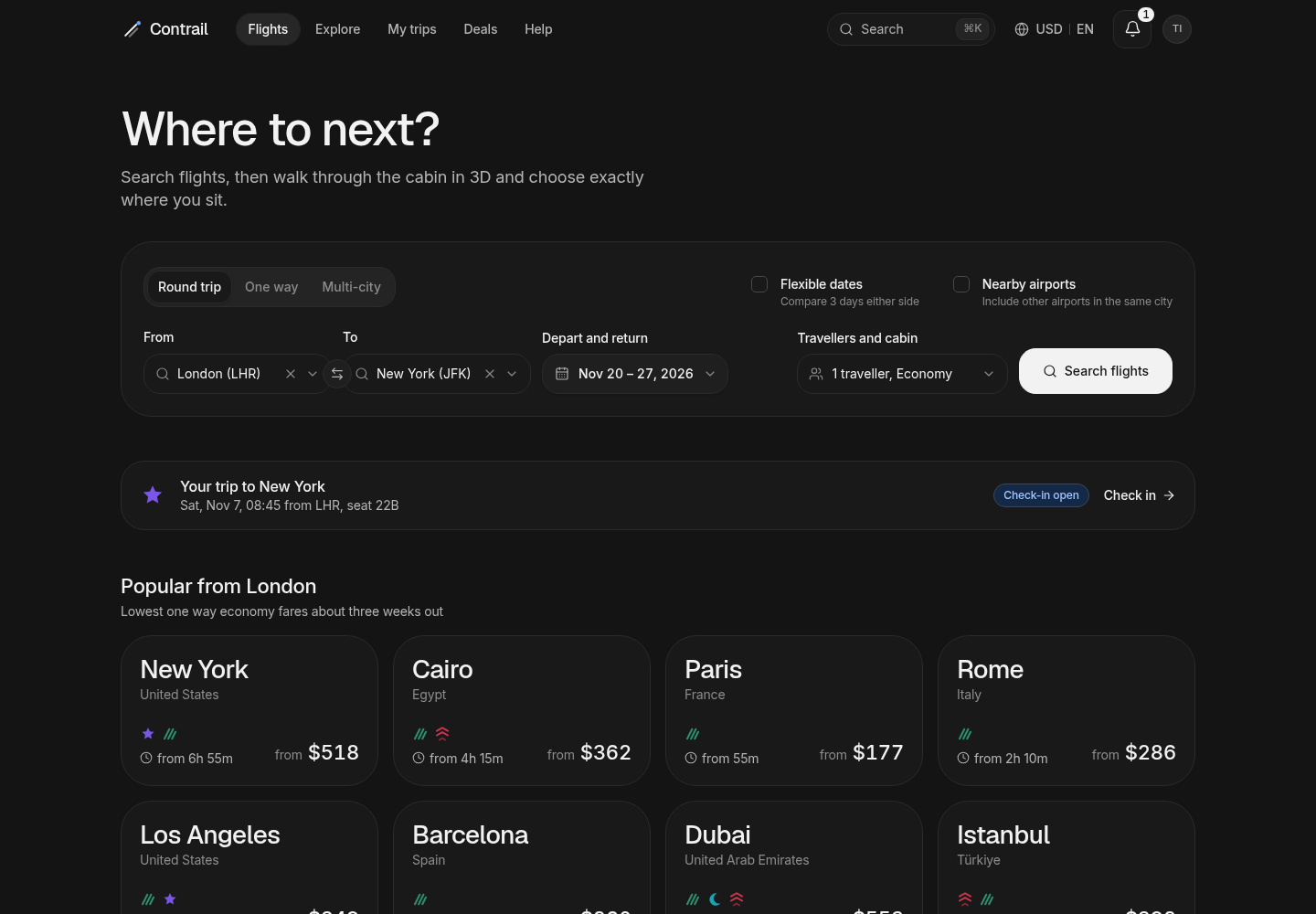
Contrail, a flight booking site Gr8r built, is that kind of site. You search flights, then pick your seat inside a 3D model of the aircraft. That is product behaviour, not page content. Built by Gr8r for its own portfolio. Not client work.
When do hosting and code control matter?
When someone asks "where does this run, and can we see the code?" and the answer is no.
Framer is clear about its side. Its help center says it does not offer HTML export for self hosting, though a separate data portability page says published site files can be downloaded. The export article adds: "If you require complete control over hosting infrastructure or need to export source code, Framer may not be the right solution for that workflow" (Framer Help, Can I export my website to HTML and self-host it?, updated 15 Sep 2026, fetched 25 Oct 2026).
Webflow lets you export code on paid Workspace plans. But its help center lists what stays behind: CMS content, user accounts, ecommerce, localized content, site search and native forms (Webflow Help, How do I export my Webflow site code?, updated 31 Oct 2025, fetched 25 Oct 2026).
For most startups this never comes up. It does when a large customer sends a security questionnaire.
Is a slow site a reason to leave?
Measure before you blame the platform.
Google's Core Web Vitals give you three numbers. Largest Contentful Paint should happen "within 2.5 seconds", Interaction to Next Paint should be "200 milliseconds or less", and Cumulative Layout Shift should be 0.1 or less, measured at the 75th percentile of page loads (web.dev, Web Vitals, last updated 31 Oct 2024, fetched 25 Oct 2026).
How to check: run your homepage and pricing page through PageSpeed Insights on mobile. Then look at the Core Web Vitals report in Search Console, which uses real visitor data.
If you fail, look at the page first. A huge hero video, a pile of tracking scripts and uncompressed photos slow any site on any stack. Fix those. If it still fails because of code you cannot touch, count it as a sign.
What are the false signs?
Some frustrations feel like platform problems. A rebuild will not fix them.
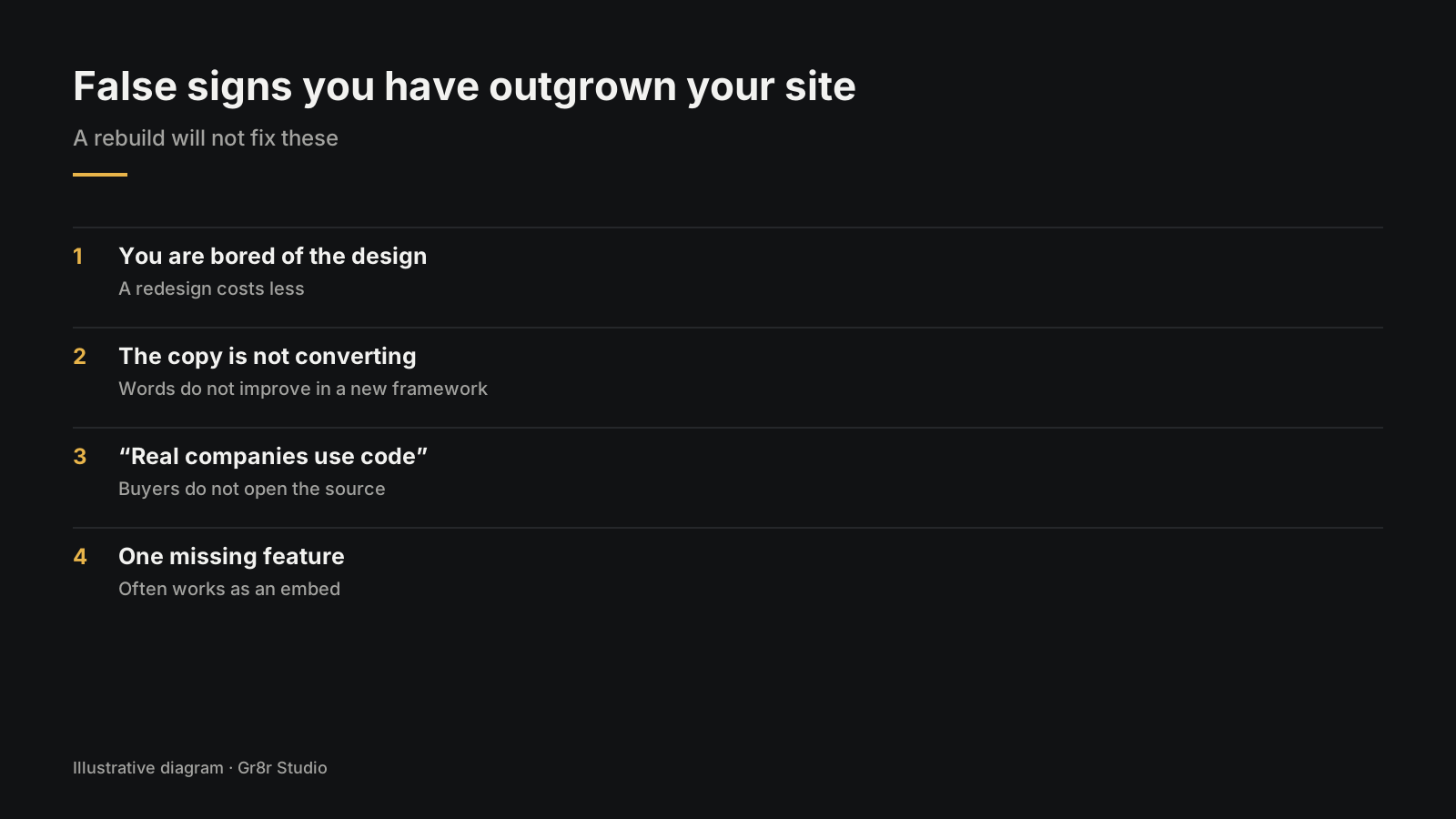
- You are bored of the design. A redesign on the same platform costs less than a new stack.
- The copy is not converting. Words do not get better in a new framework.
- "Real companies use code." Your buyers do not open the source.
- One missing feature. A form, a chat widget or a scheduler often works as an embed.
Here is an illustration, not a real client. A SaaS team plans a move to custom code because the site "feels slow and dated". A look at the pages shows three uncompressed hero images and a blog that was never put in the CMS. Fixing both takes a week. The move is no longer needed.
What does it mean when every change needs a developer?
The main gift of a no code site is that marketing can publish alone. When that stops, you pay for no code and still wait in a queue.
Signs: the CMS covers the blog but not case studies or jobs. Pages were built as one offs. Code blocks sit in the site head and nobody dares touch them.
Sometimes the fix is a proper rebuild on the same platform. The test: count last month's edits that needed a developer. If it is most of them, the no code benefit is gone.
What does moving to custom code actually involve?
A rebuild of the pages and a move of the content. Not a copy and paste.
Plan for these steps:
- List every live URL, from your sitemap and your analytics.
- Export your content. Webflow exports any CMS Collection as a CSV (Webflow Help, How do I import content into the Webflow CMS?, updated 18 Aug 2026, fetched 25 Oct 2026). Framer says CMS content "can be exported using plugins into structured formats such as CSV or JSON" (Framer Help, Porting your data from Framer, updated 15 Sep 2026, fetched 25 Oct 2026).
- Rebuild the pages in the new stack.
- Map every old URL to a new one with 301 redirects.
- Test on staging, on real phones, before the switch.
- Switch DNS and watch Search Console for errors.
The full steps, with what each platform lets you take, are in our post on leaving Framer or Webflow.
Will you lose search traffic when you migrate?
Not if every old URL points somewhere useful.
Webflow's help center puts it simply: Google will index your new structure in time, "however, 301 redirects are a best practice, especially if you want to maintain ranking power from the old URL" (Webflow Help, How do I set up redirects in Webflow?, updated 19 May 2026, fetched 25 Oct 2026).
Keep URLs the same where you can. Otherwise redirect each old page to its closest new page, not the homepage, and check Search Console daily for two weeks.
How does Gr8r help startups decide?
We look at the site you have before we suggest a new one. We designed and built the Webflow website for Orthotropic. For HostOp, we designed the product, built its Framer website and built an agentic design system for it.
If you work with us, you see a first concept within 48 hours of kickoff and a revised draft by day 2 to 3. Clients own everything once it's paid for. See our website design and development page, or start with a free UX audit, open to the first 5 companies that ask.
Frequently asked questions
When should a startup move from a no code website to custom code?
Move when the site has to act like the product: it needs live data from your app, shared sign in with the app, more content than your plan allows, or hosting and code your team controls. If only one of these applies, try a fix on your current platform first.
Can a no code site handle a growing startup?
Often, yes. Many startups run on Framer or Webflow for years. Check your plan limits, how much of the site lives in the CMS, and whether marketing can publish without a developer. Trouble starts when the site needs your product's data or accounts.
Will we lose SEO when we migrate to a new site?
Not if you plan it. List every live URL, keep URLs the same where you can, set a 301 redirect from each old page to its closest new page, and watch Search Console for errors in the weeks after launch.
Is a slow website a reason to leave a no code platform?
Only after you measure. Check Core Web Vitals in PageSpeed Insights and Search Console, then fix heavy images, videos and extra scripts. If the site still fails and the cause is code you cannot change, it counts as a reason to move.
Does Gr8r build both no code and custom code websites?
Yes. Gr8r designed and built the Webflow website for Orthotropic. For HostOp, we designed the product, built its Framer website and built an agentic design system for it. Our website design and development page explains how we work on new sites and rebuilds.
About the author
Tanjim Islam is the founder and CEO of Gr8r Studio. He founded the studio in 2023. Here he writes about how Gr8r approaches hiring, product design and AI engineering. More on the About page.
If you want help with this, book a 30 minute call.