

How to Choose a SaaS Website Design Agency

Tanjim Islam
Founder & CEO · · 7 min read


This guide is for SaaS founders and marketing leads with a shortlist and a decision to make. Every check here is one you can run yourself, from your phone, before you sign. We do not rank studios or name any. You do the ranking, with a method. If you are hiring for a Framer build, our Framer agency guide adds the Framer specific checks.
What should a SaaS website design agency deliver?
A site that moves a visitor to one of two places: a booked demo or a started trial. Everything else supports those two paths.
For most SaaS companies that means a homepage that says who it is for, product pages with real screens, a pricing page, a blog or resource section, and about and contact pages with real people on them. Then the hard part: the moment a visitor leaves your site for your app. The sign up button, the demo form, the calendar. If that handoff breaks, the pretty pages do not matter.
Ask each studio which of these they design, which they build, and which they expect you to bring.
What should you write down before you call anyone?
One page. Three lines.
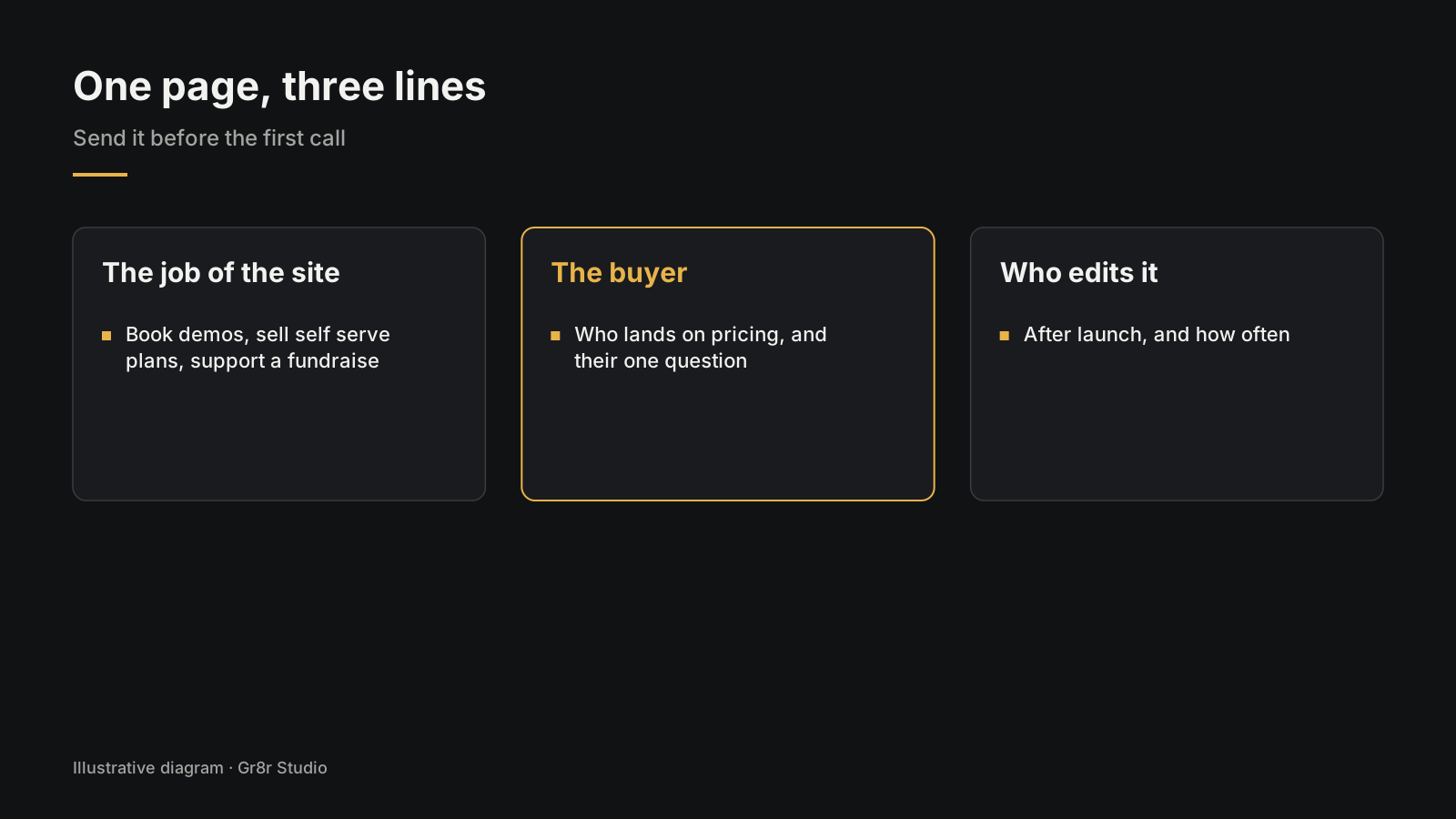
- The job of the site. Book demos, sell self serve plans, support a fundraise, or explain a new category.
- The buyer. The person who lands on your pricing page. Their job title, and the one question they need answered.
- Who edits it after launch. A marketer who publishes weekly needs a different build from a founder who touches the site twice a year.
Send this page before the first call. A good studio's first questions will be about your buyer. A weak one will go straight to its own portfolio.
How do you check a studio's live SaaS sites?
Ask for three live SaaS sites they designed and built. Not screenshots. URLs. Then open each one on your phone and run five checks. It takes about 20 minutes.
- Find the price. Can you reach pricing, or a clear way to learn it, in two taps?
- Book a demo. Fill in the form. Does it confirm, and do you know what happens next?
- Run a speed check. Put the homepage into PageSpeed Insights on mobile. Google's thresholds for a good experience: Largest Contentful Paint "within 2.5 seconds", Interaction to Next Paint "200 milliseconds or less", Cumulative Layout Shift "0.1 or less" (web.dev, Web Vitals, last updated 31 Oct 2024, fetched 25 Oct 2026). One slow page is not a verdict. Three are a pattern.
- Check the contrast. Pale grey text on white looks elegant and fails readers. WCAG 2.2 asks for a contrast ratio of "at least 4.5:1" for normal text (W3C, Understanding Success Criterion 1.4.3: Contrast (Minimum), fetched 25 Oct 2026). Any free contrast checker will tell you in seconds.
- Open the blog and a case study. Do they share a clean layout, or does each page look hand built? Hand built usually means your marketer will need the studio for every new post.
Write down what you saw. You will use it in the scorecard below.
You can practise on Atlas, a design agency site Gr8r built for a fictional studio. Its first screen has one headline, a "Start a project" button and a "See the work" link. Built by Gr8r for its own portfolio. Not client work.
Who will actually do the work?
The people on the sales call should be the people in your project. Ask for names.
Three jobs matter on a SaaS site: who writes the words, who designs the pages, and who builds them. Many problems start when nobody owns the words. The studio waits for your copy. You wait for their design. Three weeks go by.
Ask:
- "Who writes the copy, and do they talk to our customers or read our sales calls?"
- "Who designs, and who builds? Are they the same person?"
- "Who do we talk to every week?"
If the answer to the copy question is "you send us the text", plan for that work on your side, and put a date on it.
Who should own the site at the end?
You. Get it in writing before you start.
Both big no code platforms have a built in handoff. Framer's Project Transfers move a finished project to you: "The recipient becomes the new project owner after accepting the transfer", and the site stays online while it happens (Framer Help, Transfer a project to another user, updated 15 Sep 2026, fetched 25 Oct 2026). Webflow lets studios on a Freelancer or Agency Workspace plan transfer a site with its Site plan and custom domain to a client's Workspace, "with no downtime or loss of unused Site plan time" (Webflow Help, How do I transfer a site or plan to another workspace?, updated 1 Aug 2026, fetched 25 Oct 2026). For a custom code site, the repository should live in your company's account.
Put these in the contract:
- The project, or the code repository, moves to an account you own at launch.
- The domain is registered in your company's name.
- Analytics, forms and connected tools sit in your accounts.
- Design files are handed over.
Note one detail from Webflow's own docs: on transfer, form notification settings and reCAPTCHA keys reset. Test your forms the day after any handoff.
Can your marketer run the site without the studio?
Picture your marketer on the Tuesday after launch. They need to publish a post, add a customer story and change the headline on the pricing page. A good build lets them do all three alone.
Ask each studio to share its screen and show the CMS of a site it launched. Which collections did they set up? Can a marketer add a new case study without touching the design? What happens when you need a field nobody planned for?
Then ask what the handoff includes: a recorded walkthrough, a short written guide, and a window after launch for questions.
How do you see how a studio thinks before you sign?
Ask for thinking, not free work.
Two fair asks:
- A ten minute critique of your current homepage. What would they change first, and why? You learn whether they read your buyer or just your colors.
- A small paid first step. A homepage concept or a short audit, with a clear price and date, before the full project.
Watch how they handle the critique. Specific is good: "your pricing page hides the annual plan". Vague is a warning: "it needs to feel more premium".
How do you compare two or three studios fairly?
Use one scorecard for every studio, and score what you saw, not what you were told. Give each row 0, 1 or 2.
The weights are yours. A team with a strong in house writer can care less about copy. A team that publishes every week should care most about the CMS. Our 15 questions to ask before hiring a software development company covers the wider hiring questions, and red flags when hiring a software partner covers the warning signs, so we do not repeat them here.
How does Gr8r work on SaaS websites?
We start with your buyer and the two paths on your site: demo and trial. You see a first concept within 48 hours of kickoff and a revised draft by day 2 to 3. Clients own everything once it's paid for.
Our founder, Tanjim Islam, is a Framer Expert. Gr8r Studio also has its own Framer profile. For HostOp, we designed the product, built its Framer website and built an agentic design system for it. See the website design and development page for how we work.
Frequently asked questions
How do you choose a SaaS website design agency?
Test its live work. Open three of its SaaS sites on your phone, find pricing, book a demo, run a speed check and check text contrast. Ask who writes, designs and builds, get ownership in writing, and score every studio on the same sheet.
What does a SaaS website design agency do?
It designs and builds the marketing site for a software company: homepage, product pages, pricing, blog and contact. A good one also plans the paths to a booked demo or a started trial, and the handoff from your site to your app.
Should the agency write the website copy?
It helps if someone on their team owns the words, because copy and design shape each other. If you will write it yourself, agree on who delivers which page and by what date before work starts.
Who should own the website after launch?
You should. Ask for the Framer project, the Webflow site or the code repository to move into an account you own, with the domain, analytics and forms in your company's name. Put this in the contract.
How fast does Gr8r show a first design?
Gr8r shows a first concept within 48 hours of kickoff and a revised draft by day 2 to 3. Clients own everything once it's paid for.
About the author
Tanjim Islam is the founder and CEO of Gr8r Studio. He founded the studio in 2023. Here he writes about how Gr8r approaches hiring, product design and AI engineering. More on the About page.
If you want help with this, book a 30 minute call.